Introduction
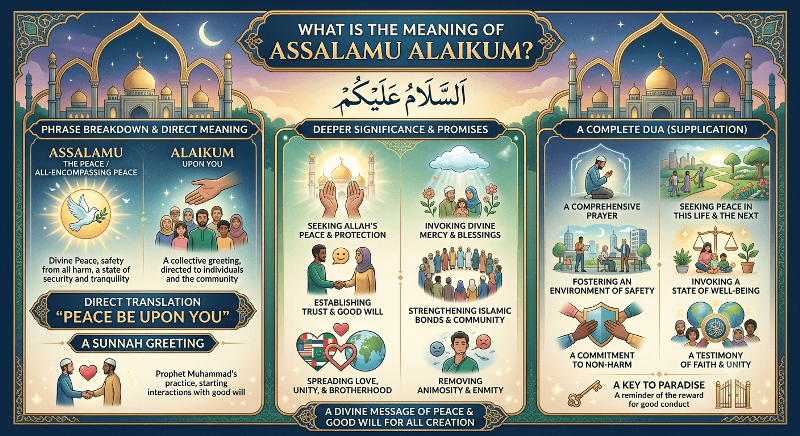
Every time a Muslim says “Assalamu Alaikum”, they are doing something truly extraordinary — they are invoking one of the beautiful names of Allah and offering a sincere prayer of peace, mercy, and blessing upon their fellow believer.
As-Salam (السَّلَام) — Peace — is one of the 99 names of Allah. When you say Assalamu Alaikum, you are essentially saying: “May Allah’s peace be with you — may you be under His protection and in His company.” This is not just a greeting — it is a du’a (supplication), a gift, and an act of worship all at once.
The Prophet Muhammad ﷺ placed such immense importance on this greeting that he identified it as one of the best acts in Islam. In this guide, we explore the meaning, Arabic text, three forms, benefits, and the correct times to say Assalamu Alaikum.
What Does Assalamu Alaikum Mean?
Assalamu Alaikum (اَلسَّلَامُ عَلَيْكُمْ) is an Arabic greeting that carries a meaning far deeper than any ordinary “hello” or “hi.” It is a heartfelt prayer for the person you are greeting, asking Allah to bless them with His peace, mercy, and protection.
The Name Behind the Greeting — As-Salam
| Detail | Info |
| As-Salam (السَّلَام) | One of the 99 Beautiful Names of Allah |
| Meaning of As-Salam | The Source of Peace, The Flawless, The Giver of Security |
| What the greeting means | “May Allah’s peace, protection, and company be upon you” |
| Type of act | A du’a (supplication) + Sunnah + act of worship |
When you greet someone with Assalamu Alaikum, you are not just being polite — you are gifting them a du’a from the name of Allah Himself.
The 3 Forms of Assalamu Alaikum — From Basic to Complete
Islam has given us three progressive forms of this blessed greeting — each one carrying more reward than the previous:
Form 1: Assalamu Alaikum (Basic Form)
اَلسَّلَامُ عَلَيْكُمْ
Transliteration: Assalamu Alaikum Meaning in English: “Peace be upon you.” Reward: 10 good deeds (Hasanat)
This is the minimum form of the Islamic greeting — valid, accepted, and rewarded. It is the simplest way to offer peace to a fellow Muslim.
Form 2: Assalamu Alaikum Warahmatullah (Intermediate Form)
اَلسَّلَامُ عَلَيْكُمْ وَرَحْمَةُ اللهِ
Transliteration: Assalamu Alaikum Warahmatullah Meaning in English: “Peace and the mercy of Allah be upon you.” Reward: 20 good deeds (Hasanat)
This form adds “Warahmatullah” — and the mercy of Allah — elevating the greeting with a prayer for Allah’s special mercy upon the person you are greeting.
Form 3: Assalamu Alaikum Warahmatullahi Wabarakatuhu (Complete Form)
اَلسَّلَامُ عَلَيْكُمْ وَرَحْمَةُ اللهِ وَبَرَكَاتُهُ
Transliteration: Assalamu Alaikum Warahmatullahi Wabarakatuhu Meaning in English: “Peace, mercy, and blessings of Allah be upon you.” Reward: 30 good deeds (Hasanat)
This is the most complete and most rewarded form of the Islamic greeting. It encompasses three divine gifts — peace, mercy, and blessings — all in one beautiful phrase.
The Prophet Muhammad ﷺ confirmed the rewards of each form in the following Hadith:
“A man came to the Prophet ﷺ and said: ‘Assalamu Alaikum.’ The Prophet ﷺ said: ’10 (good deeds).’ Another man came and said: ‘Assalamu Alaikum Warahmatullah.’ The Prophet ﷺ said: ’20.’ Another came and said: ‘Assalamu Alaikum Warahmatullahi Wabarakatuhu.’ The Prophet ﷺ said: ’30.’” — [Sunan Abu Dawud & At-Tirmidhi]
Word-by-Word Breakdown of the Complete Greeting
| Arabic | Transliteration | Meaning |
| اَلسَّلَامُ | As-Salamu | The Peace (a name of Allah) |
| عَلَيْكُمْ | Alaikum | Be upon you |
| وَرَحْمَةُ | Wa Rahmatu | And the mercy of |
| اللهِ | Allah | Allah |
| وَبَرَكَاتُهُ | Wa Barakatuhu | And His blessings |
Full meaning: “The Peace of Allah, His Mercy, and His Blessings be upon you.”
Three Forms Compared — At a Glance
| Form | Arabic | English Meaning | Reward |
| Basic | اَلسَّلَامُ عَلَيْكُمْ | Peace be upon you | 10 good deeds |
| Intermediate | اَلسَّلَامُ عَلَيْكُمْ وَرَحْمَةُ اللهِ | Peace and mercy of Allah be upon you | 20 good deeds |
| Complete | اَلسَّلَامُ عَلَيْكُمْ وَرَحْمَةُ اللهِ وَبَرَكَاتُهُ | Peace, mercy and blessings of Allah be upon you | 30 good deeds |
Always aim for the complete form — Assalamu Alaikum Warahmatullahi Wabarakatuhu — for the greatest reward with every single greeting.
What is the Benefit of Saying Assalamu Alaikum?
The Hadith That Defines Its Importance
Abdullah ibn Amr (RA) narrated:
“A man asked the Messenger of Allah ﷺ: ‘Which act in Islam is the best?’ The Prophet ﷺ replied: ‘To give food, and to give the Salam to everyone — whether you know them or not.’” — [Collected by Al-Bukhari & Muslim]
This single Hadith reveals three extraordinary truths about the Salam:
- It is one of the best acts in all of Islam — not just a nice habit, but a top-ranked deed
- It should be given to everyone — not just friends and family, but strangers too
- It is paired with feeding others — two of the most beloved social acts in Islam
Spiritual & Social Benefits of Assalamu Alaikum
The greeting of Salam carries profound benefits for the individual, the relationship, and the entire Muslim community:
Spiritual Benefits:
- Earns 10 to 30 good deeds with every single greeting
- Invokes the name of Allah — As-Salam — in every interaction
- Follows the Sunnah of the Prophet Muhammad ﷺ
- Is a du’a for the person you greet — a selfless act of worship
- One of the best acts in Islam — as confirmed in Sahih Al-Bukhari & Muslim
- Spreads the blessings of Allah — peace, mercy, and barakah
Social & Community Benefits:
- Generates mutual love between Muslims
- Removes hatred, envy, and ill-will from hearts
- Strengthens the bonds of brotherhood and sisterhood in the Ummah
- Creates a welcoming, warm environment in homes, masajid, and communities
- Breaks barriers — greeting strangers with Salam opens hearts and builds trust
- Unites the Muslim Ummah — one universal greeting across all languages and cultures
The Prophet ﷺ said:
“You will not enter Paradise until you believe, and you will not believe until you love one another. Shall I not tell you of something that, if you do it, you will love one another? Spread the Salam amongst yourselves.” — [Sahih Muslim]
When Should You Say Assalamu Alaikum?
The Salam is the Islamic greeting for all occasions. Here are the key times when it is Sunnah to say it:
| Occasion | When to Say Salam |
| Meeting a Muslim | Say Salam whenever you meet a Muslim brother or sister |
| Entering a gathering (Majlis) | Say Salam upon entering any Islamic gathering or meeting |
| Starting a phone call | Begin every phone conversation with Assalamu Alaikum |
| Leaving a gathering | Say Salam when departing — it is Sunnah to greet at arrival and departure |
| After Salah (Prayer) | Say Salam at the end of every prayer (Tasleem) |
| Before a speech or Khutbah | Begin any Islamic speech, lecture, or Friday Khutbah with Salam |
| Entering your home | Say Salam when entering your own home — even if no one is there |
| Beginning a letter or message | Start all Islamic correspondence with the Salam |
How to Respond to Assalamu Alaikum
When someone greets you with Salam, you are obligated to respond — and it is best to respond with an equal or better greeting:
| Greeting Received | Minimum Response | Better Response |
| Assalamu Alaikum | Wa Alaikum Assalam | Wa Alaikum Assalam Warahmatullahi Wabarakatuhu |
| Assalamu Alaikum Warahmatullah | Wa Alaikum Assalam Warahmatullah | Wa Alaikum Assalam Warahmatullahi Wabarakatuhu |
| Assalamu Alaikum Warahmatullahi Wabarakatuhu | Wa Alaikum Assalam Warahmatullahi Wabarakatuhu | (This is already the complete form) |
Allah says in the Qur’an:
“When you are greeted with a greeting, respond with a better one or at least return it equally. Indeed, Allah keeps account of all things.” — Surah An-Nisa (4:86)
Important Rules About the Islamic Greeting
| Rule | Detail |
| Who initiates? | The one arriving greets first; the younger greets the elder; the one riding greets the one walking |
| Non-Muslims | Do not initiate Salam to non-Muslims; if they greet you, respond with “Wa Alaikum” only |
| Responding is obligatory | Responding to Salam is Fard Kifayah (a communal obligation) |
| No substitute | No other greeting — handshake, wave, or nod — can replace the Islamic Salam |
| Entering an empty house | Say “Assalamu Alaina wa ala ibadillahis-saliheen” when entering an empty home |
Why is the Islamic Greeting Superior to All Others?
In a world of “Hello”, “Hi”, “Hey”, and countless other greetings, the Islamic Salam stands alone in its depth, meaning, and reward:
| Ordinary Greeting | Islamic Salam |
| Just a social formality | A du’a and an act of worship |
| Carries no spiritual reward | Earns 10–30 good deeds instantly |
| No connection to God | Invokes the name of Allah |
| Creates no spiritual bond | Generates love and removes hatred |
| Can be replaced by other greetings | Has no substitute in Islam |
The Prophet ﷺ said:
“The best of the two people is the one who begins with the Salam.” — [Sahih Al-Bukhari]
Quick Reference Card — Assalamu Alaikum
| Detail | Info |
| Arabic | اَلسَّلَامُ عَلَيْكُمْ وَرَحْمَةُ اللهِ وَبَرَكَاتُهُ |
| Transliteration | Assalamu Alaikum Warahmatullahi Wabarakatuhu |
| Meaning | Peace, mercy and blessings of Allah be upon you |
| Best Form | Complete form — 30 good deeds per greeting |
| Response | Wa Alaikum Assalam Warahmatullahi Wabarakatuhu |
| Key Hadith | “Spread Salam amongst yourselves” (Sahih Muslim) |
| Quranic Reference | Surah An-Nisa (4:86) |
Conclusion
Assalamu Alaikum is more than a greeting — it is a way of life. Every time you say it, you are earning good deeds, spreading the peace of Allah, following the Sunnah of the Prophet ﷺ, and strengthening the bond of love within the Muslim Ummah.
The Prophet ﷺ told us that spreading the Salam is the path to love, and love is the path to Jannah. Something as simple as a greeting — said sincerely, said completely, said to everyone you meet — can transform your relationships, your community, and your standing with Allah.
So let us make it our mission — starting today — to greet every Muslim we meet with the complete, beautiful Salam:
اَلسَّلَامُ عَلَيْكُمْ وَرَحْمَةُ اللهِ وَبَرَكَاتُهُ
Assalamu Alaikum Warahmatullahi Wabarakatuhu
May Allah (SWT) accept all our good deeds, fill our hearts with love for one another, forgive our shortcomings, and make us among the people of Taqwa. May He, by His infinite Mercy, grant us all entry into Jannah. Ameen, Ya Rabbal ‘Alameen.
Jazakallahu Khayran!
Tags: Assalamu Alaikum meaning, Assalamu Alaikum Warahmatullahi Wabarakatuhu meaning, Islamic greeting in English, 3 forms of Salam in Islam, benefits of saying Assalamu Alaikum, when to say Salam in Islam, As-Salam name of Allah, how to respond to Assalamu Alaikum, Salam in Islam, Islamic Sunnah greeting
