Introduction
Once a year, the holy city of Makkah becomes the gathering point for over 2 million Muslims from every corner of the world — different languages, different nationalities, different backgrounds — all dressed in the same simple white garments, answering the same timeless call:
لَبَّيْكَ اللَّهُمَّ لَبَّيْكَ
“Labbayk Allahumma Labbayk — Here I am, O Allah, Here I am.”
This is Hajj — the fifth and final pillar of Islam — and it is unlike any other act of worship on earth. It is the peak of a Muslim’s spiritual life, a once-in-a-lifetime journey that wipes away all sins, demonstrates the universality of Islam, and brings the believer face to face with the reality of standing before Allah.
In this comprehensive guide, we explore the meaning, Quranic evidence, rituals, merits, and profound benefits of Hajj in Islam.
What is the Fifth Pillar of Islam?
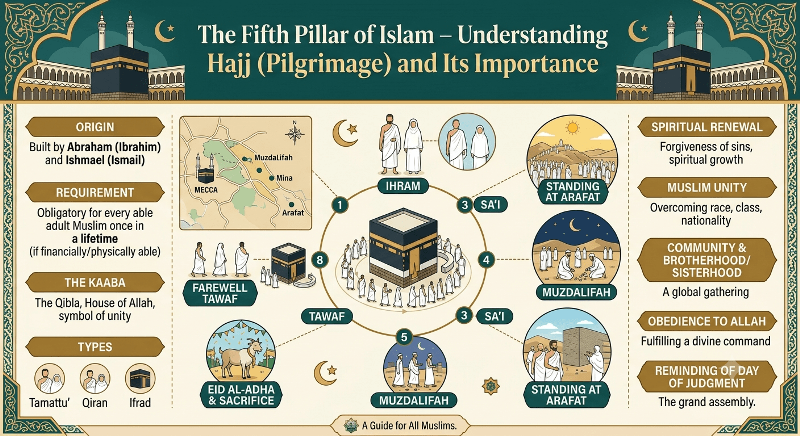
The fifth pillar of Islam is Hajj — the obligatory pilgrimage to the holy city of Makkah, Saudi Arabia. It is required at least once in a lifetime for every Muslim who is physically and financially able to make the journey.
Quick Reference Card
| Detail | Info |
| Pillar Number | Fifth and Final Pillar of Islam |
| Arabic Name | Hajj (حَجّ) |
| Literal Meaning | To intend a journey / To make a pilgrimage |
| Location | Makkah, Saudi Arabia |
| When | Month of Dhul Hijjah (12th Islamic month) |
| Duration | 8th to 13th of Dhul Hijjah |
| Who Must Perform | Every able Muslim — physically & financially |
| Frequency | Once in a lifetime (obligatory) |
| Key Quranic Reference | Surah Ali ‘Imran (3:97) |
| Primary Purpose | Obedience to Allah & remembrance of Him |
What Does the Qur’an Say About Hajj?
Allah (Subhanahu Wa Ta’ala) makes the obligation of Hajj crystal clear in one of the most powerful and direct commands in the entire Qur’an:
The Quranic Command for Hajj
وَلِلَّهِ عَلَى النَّاسِ حِجُّ الْبَيْتِ مَنِ اسْتَطَاعَ إِلَيْهِ سَبِيلًا وَمَن كَفَرَ فَإِنَّ اللَّهَ غَنِيٌّ عَنِ الْعَالَمِينَ
“Pilgrimage to the House is a duty that mankind owes to Allah — for those who are able to make the journey. And whoever disbelieves — then indeed, Allah is free from need of all the worlds.” — Surah Ali ‘Imran (3:97)
Key Insights From This Verse:
- “A duty mankind owes to Allah” — Hajj is not a personal choice or a luxury trip; it is a debt owed to Allah by every capable Muslim
- “For those who are able” — Islam is merciful; Hajj is only obligatory for those with the physical health and financial means to perform it
- “Whoever disbelieves” — this is a powerful warning that refusing Hajj out of denial or arrogance, while being fully able, is a matter of faith itself
- “Allah is free from need of all the worlds” — Hajj is not for Allah’s benefit — it is entirely for ours. Allah needs nothing from us; we are the ones who need Him
What is the True Meaning Behind Hajj?
Hajj is not simply a physical journey — every single ritual carries deep spiritual meaning and is rooted in the remembrance of Allah (Dhikr). This is confirmed in a powerful Hadith:
Hadith on the Meaning of Hajj Rituals
Aisha (RA) reported that the Prophet Muhammad ﷺ said:
Arabic:
“إِنَّمَا جُعِلَ الطَّوَافُ بِالْبَيْتِ وَبَيْنَ الصَّفَا وَالْمَرْوَةِ وَرَمْيُ الْجِمَارِ لِإِقَامَةِ ذِكْرِ اللَّهِ”
Meaning in English:
“The Tawaf around the House (Ka’bah), the Sa’iy between Safa and Marwah, and the throwing of the Jamarat — all of these were established for the remembrance of Allah.” — [Collected by Ahmad, Abu Dawud & At-Tirmidhi]
This Hadith reveals the soul of Hajj — beneath every ritual, every step, and every stone thrown, the true purpose is one: the remembrance and glorification of Allah. Hajj transforms a physical journey into a complete spiritual experience.
The Key Rituals of Hajj — Step by Step
Every ritual of Hajj connects the pilgrim to the legacy of the Prophet Ibrahim (AS), his wife Hajar (AS), and the Prophet Muhammad ﷺ:
| # | Ritual | Arabic | Meaning & Significance |
| 1 | Ihram | إحرام | Wearing white seamless garments — symbolizing purity, equality, and leaving the world behind |
| 2 | Tawaf | طواف | Circling the Ka’bah 7 times — expressing total devotion and submission to Allah |
| 3 | Sa’iy | سعي | Walking 7 times between Safa & Marwah — commemorating Hajar’s (AS) search for water for her son Ismail (AS) |
| 4 | Wuquf at Arafah | وقوف عرفة | Standing at the plain of Arafah — the most important ritual of Hajj, a preview of the Day of Judgment |
| 5 | Muzdalifah | مزدلفة | Spending the night under the open sky — collecting pebbles for the Jamarat |
| 6 | Rami al-Jamarat | رمي الجمرات | Throwing pebbles at the three pillars — symbolizing the rejection of Shaytan |
| 7 | Qurbani | قرباني | Sacrificing an animal — commemorating Ibrahim’s (AS) willingness to sacrifice his son for Allah |
| 8 | Halq / Taqsir | حلق / تقصير | Shaving or cutting the hair — symbolizing spiritual renewal and humility |
| 9 | Tawaf Al-Ifadah | طواف الإفاضة | The final Tawaf — completing the Hajj and celebrating Allah’s mercy |
The Merits of Hajj — What Makes It So Extraordinary?
Hadith 1 — Hajj Wipes Away All Sins
Abu Hurayrah (RA) reported that the Messenger of Allah ﷺ said:
Arabic:
“مَنْ حَجَّ لِلَّهِ فَلَمْ يَرْفُثْ وَلَمْ يَفْسُقْ رَجَعَ كَيَوْمِ وَلَدَتْهُ أُمُّهُ”
Meaning in English:
“Whoever performs Hajj for Allah and avoids obscene speech and immoral behavior will return (cleansed of his sins) like the day his mother gave birth to him.” — [Collected by Al-Bukhari & Muslim]
The Power of This Hadith:
This is one of the most extraordinary promises in all of Islam. A sincere, accepted Hajj does not merely reduce sins — it erases them completely, returning the pilgrim to a state of total purity, as if they had just been born. This is the mercy of Allah at its most breathtaking.
But this promise comes with two important conditions:
| Condition | Meaning |
| “For Allah” | Hajj must be performed with pure intention — solely for Allah, not for status, show, or social expectation |
| “Avoids obscene speech and immoral behavior” | The pilgrim must guard their tongue, actions, and character throughout Hajj |
Hadith 2 — The Reward of Accepted Hajj is Nothing Less Than Jannah
Abu Hurayrah (RA) also reported that the Messenger of Allah ﷺ said:
Arabic:
“الْعُمْرَةُ إِلَى الْعُمْرَةِ كَفَّارَةٌ لِمَا بَيْنَهُمَا وَالْحَجُّ الْمَبْرُورُ لَيْسَ لَهُ جَزَاءٌ إِلَّا الْجَنَّةُ”
Meaning in English:
“One Umrah to another Umrah erases the sins committed between them — and an accepted Hajj (Hajj Mabrur) has no reward except Al-Jannah (Paradise).” — [Collected by Al-Bukhari & Muslim]
Breaking Down This Remarkable Hadith:
This Hadith contains two extraordinary promises:
Promise 1 — Umrah erases sins between visits: Every time a Muslim performs Umrah, all the sins committed since their previous Umrah are wiped clean. This makes Umrah one of the most powerful acts of worship for continuous spiritual renewal.
Promise 2 — Hajj Mabrur earns nothing less than Jannah: Hajj Mabrur — an accepted, sincere, properly performed Hajj — carries a reward so immense that the Prophet ﷺ could only describe it with one word: Jannah (Paradise). There is no worldly equivalent. There is no partial reward. The only fitting return for a sincere Hajj is eternal Paradise.
What is Hajj Mabrur? — The Key to Earning Jannah
Hajj Mabrur is an accepted, blessed Hajj that meets the following conditions:
| Condition | Explanation |
| Pure Intention (Ikhlas) | Performed solely for the sake of Allah — not for prestige or social status |
| Halal Funds | Financed entirely from lawful (halal) earnings |
| Correct Performance | All rituals performed according to the Sunnah of the Prophet ﷺ |
| Good Character | Maintaining patience, kindness, and avoiding all sins throughout Hajj |
| Positive Change After Hajj | A sign of accepted Hajj is that the pilgrim returns as a better, more righteous Muslim |
The Prophet ﷺ was asked: “What is Hajj Mabrur?” He replied:
“Feeding others and spreading the greeting of peace (Salam).” — [Musnad Ahmad]
Benefits of Hajj — Why Every Muslim Longs to Go
Spiritual Benefits:
- The ultimate act of obedience to Allah — above all else
- Complete forgiveness of all past sins — returning pure as a newborn
- The only reward is Jannah — for an accepted Hajj (Hajj Mabrur)
- Deepens Taqwa — the journey transforms a Muslim’s relationship with Allah
- Strengthens Iman (faith) — witnessing the signs of Allah in Makkah and Madinah
- Connection to the Prophets — walking in the footsteps of Ibrahim ﷺ and Muhammad ﷺ
Universal & Social Benefits:
- Demonstrates the universality of Islam — Muslims from every race, nation, and background stand as one
- Greatest symbol of Muslim unity — over 2 million pilgrims united in one place, one purpose, one Lord
- Eliminates racial and social inequality — in Ihram, there is no king and no pauper — all are equal before Allah
- Strengthens the bonds of the global Ummah — Muslims share experiences, knowledge, and brotherhood
Personal & Character Benefits:
- Reminds us of the Day of Judgment — the gathering at Arafah mirrors the Day of Resurrection
- Teaches patience and sacrifice — the physical demands of Hajj build resilience and reliance on Allah
- Promotes gratitude — experiencing the blessings of Zamzam, the Ka’bah, and Allah’s mercy firsthand
- Transforms character — a pilgrim who returns from Hajj Mabrur is a renewed, better Muslim
Hajj vs Umrah — What is the Difference?
Many Muslims wonder about the difference between Hajj and Umrah:
| Hajj | Umrah | |
| Obligation | Obligatory (Fard) — once in a lifetime | Highly recommended (Sunnah) — not obligatory |
| Timing | Only during Dhul Hijjah (specific dates) | Any time of the year |
| Duration | 5-6 days of rituals | Can be completed in a few hours |
| Key Ritual | Standing at Arafah (Wuquf) — essential for Hajj | Does not include Wuquf at Arafah |
| Reward | Jannah for Hajj Mabrur | Erases sins since previous Umrah |
Both are profound acts of worship — but Hajj is the greater of the two in obligation, rituals, and spiritual significance.
Who is Exempt From Hajj?
Islam is a religion of mercy and ease. Hajj is not obligatory for those who:
| Exemption | Reason |
| Financial inability | Cannot afford the cost of travel and stay |
| Physical illness or disability | Cannot endure the physical demands of Hajj |
| Lack of safety | The journey poses a genuine risk to life |
| Women without a Mahram | A woman must have a male guardian (Mahram) to travel for Hajj |
| Children | Hajj is not obligatory until adulthood — though it is valid and rewarded |
Allah says:
“Allah does not burden a soul beyond that it can bear.” — Surah Al-Baqarah (2:286)
Hajj — A Preview of the Day of Judgment
One of the most profound aspects of Hajj is how powerfully it mirrors the Day of Judgment (Yawm Al-Qiyamah):
| Hajj Experience | Day of Judgment Parallel |
| Millions gathered at Arafah in white garments | Billions gathered on the plains of resurrection |
| All are equal — no wealth, no status, no titles | All will stand before Allah equally |
| Accountability for every action during Hajj | Every soul will be accountable for every deed |
| Seeking forgiveness and mercy at every step | Every soul will desperately seek Allah’s mercy |
| The journey ends with returning home renewed | The Hereafter begins with either Jannah or Jahannam |
This is why Hajj reminds every pilgrim of their mortality and their ultimate return to Allah — making it the most spiritually awakening experience in a Muslim’s life.
Summary — Hajj at a Glance
| Aspect | Detail |
| What is it? | Obligatory pilgrimage to Makkah — 5th Pillar of Islam |
| Who must perform? | Every able Muslim — physically & financially |
| When? | Dhul Hijjah 8th–13th (Islamic lunar calendar) |
| Key rituals | Ihram, Tawaf, Sa’iy, Arafah, Jamarat, Qurbani |
| Greatest merit | Complete forgiveness of all sins |
| Ultimate reward | Jannah — for Hajj Mabrur |
| Deeper purpose | Remembrance of Allah & preview of the Day of Judgment |
| Key Hadith | “No reward for Hajj Mabrur except Jannah” (Bukhari & Muslim) |
Conclusion
Hajj is the crown jewel of Islamic worship — the fifth and final pillar of Islam that brings together every dimension of a Muslim’s faith: submission, sacrifice, unity, remembrance, and hope. It is the journey of a lifetime, the peak of devotion, and the closest a Muslim can come — in this world — to standing before Allah.
Whether you have already performed Hajj or are still dreaming of the day you will answer that call, let Hajj be a constant reminder of why we were created, where we are going, and what truly matters in this fleeting life.
May Allah (Subhanahu Wa Ta’ala) grant every Muslim the opportunity to perform Hajj at least once in their lifetime, accept it as Hajj Mabrur, wipe away all our sins, grant us the reward of Jannah, and reunite us with our beloved Prophet Muhammad ﷺ in the highest ranks of Paradise. Ameen, Ya Rabbal ‘Alameen.
Jazakallahu Khayran!
Tags: fifth pillar of Islam, Hajj in Islam, Hajj meaning in English, rituals of Hajj, merits of Hajj, Hajj Mabrur meaning, Surah Ali Imran 3:97, Hajj vs Umrah, benefits of Hajj, who must perform Hajj, Day of Judgment and Hajj, pilgrimage to Makkah
