Introduction
Among the five pillars of Islam, Salah (prayer) holds a uniquely special place. It is the most consistent and direct act of worship in a Muslim’s daily life — performed five times every single day, from the moment a person embraces Islam until their last breath.
Unlike any other pillar, Salah was not revealed through an angel or a scripture — it was given directly to the Prophet Muhammad ﷺ during the Night of Ascension (Isra wal Mi’raj), when he was raised to the heavens to meet Allah. This alone tells us how profoundly important Salah is in the sight of Allah.
In this guide, we explore the meaning, importance, and powerful Quranic evidence for Salah — the second pillar of Islam.
What is Salah in Islam?
Salah (also written as Salat or Namaz) is the obligatory ritual prayer performed by Muslims five times daily. It is the second of the five pillars of Islam and serves as the most direct connection between a believer and Allah.
Key Facts About Salah:
| Detail | Info |
| Pillar Number | Second Pillar of Islam |
| Arabic Name | Salah (صَلَاة) |
| Also Known As | Namaz, Prayer |
| Frequency | 5 times every day |
| Made Obligatory | During Isra wal Mi’raj (Night of Ascension) |
| Can Be Performed | Alone or in congregation |
| Recommended Place | Mosque (but permissible anywhere clean) |
The Direct Relationship Between a Muslim and Allah
One of the most beautiful aspects of Salah is that it establishes a direct, personal relationship between the believer and Allah — with no intermediary, no priest, and no barrier. Every time a Muslim stands in prayer, they are in direct conversation with their Creator.
The Prophet Muhammad ﷺ said:
“When any one of you stands in prayer, he is in private conversation with his Lord.” — [Sahih Al-Bukhari]
This direct connection is what makes Salah unlike any other act of worship. It is Allah’s gift to the believers — an open line of communication, available five times every day.
Where and How Can Salah Be Performed?
Islam has made Salah accessible and flexible for every Muslim, regardless of their circumstances:
| Option | Ruling |
| Praying alone | Permissible and valid |
| Praying with another person | Meritorious — carries greater reward |
| Praying in congregation (Jama’ah) | Highly recommended — 27 times more reward |
| Praying at home | Permissible |
| Praying at work | Permissible |
| Praying outdoors | Permissible |
| Praying in a mosque | Most recommended — greatest reward |
The Prophet ﷺ said:
“Prayer in congregation is twenty-seven times superior to prayer offered alone.” — [Sahih Al-Bukhari & Muslim]
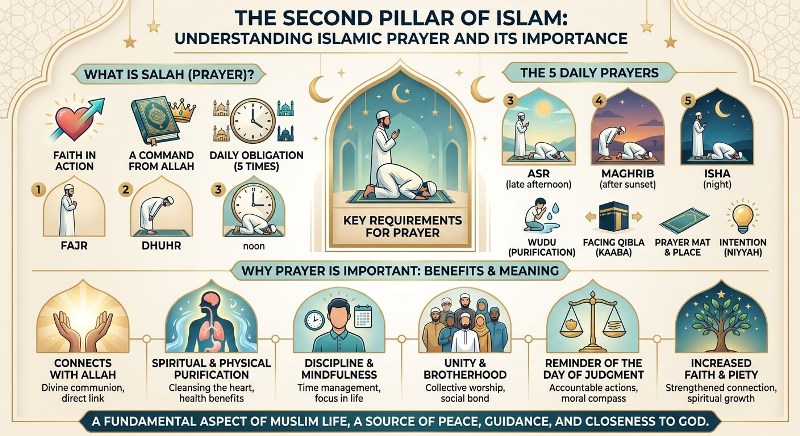
The 5 Daily Prayers in Islam
| # | Prayer | Arabic | Time |
| 1 | Fajr | فَجْر | Dawn — before sunrise |
| 2 | Dhuhr | ظُهْر | Midday — after the sun passes its zenith |
| 3 | Asr | عَصْر | Late afternoon |
| 4 | Maghrib | مَغْرِب | Just after sunset |
| 5 | Isha | عِشَاء | Night |
What Does the Qur’an Say About Salah?
The importance of Salah is not limited to one verse or one era — it is commanded across multiple prophets and multiple chapters of the Qur’an. This shows that Salah has always been a cornerstone of Allah’s religion, from the time of Ibrahim (AS) to the time of Prophet Muhammad ﷺ.
Here are five powerful Quranic verses about Salah:
Verse 1 — The Du’a of Prophet Ibrahim (AS)
Prophet Ibrahim (AS) — one of the greatest prophets in Islam — made a heartfelt supplication to Allah, asking Him to make him and his descendants people of prayer:
رَبِّ اجْعَلْنِي مُقِيمَ الصَّلَاةِ وَمِن ذُرِّيَّتِي
“O my Lord! Make me one who establishes Salah, and also from my offspring.” — Surah Ibrahim (14:40)
Reflection: If Prophet Ibrahim (AS) — the father of monotheism — felt the need to ask Allah to keep him steadfast in Salah, how much more do we need to ask the same? This verse teaches us that consistency in Salah is a gift from Allah, not just a personal effort.
Verse 2 — Allah Commands Prophet Musa (AS)
When Allah spoke directly to Prophet Musa (AS) from the burning bush, one of His very first commands was to establish Salah:
وَأَقِمِ الصَّلَاةَ لِذِكْرِي
“And establish Salah for My remembrance.” — Surah Taha (20:14)
Reflection: This verse reveals the core purpose of Salah — it is an act of Dhikr (remembrance of Allah). Salah is not a burden or a routine — it is a reminder that Allah is always present, and we must always return to Him.
Verse 3 — Prophet Isa (AS) Was Commanded to Pray
Even Prophet Isa (Jesus — peace be upon him) was commanded by Allah to establish Salah throughout his life:
وَأَوْصَانِي بِالصَّلَاةِ وَالزَّكَاةِ مَا دُمْتُ حَيًّا
“And He has enjoined upon me Salah and Zakah as long as I live.” — Surah Maryam (19:31)
Reflection: Salah is not unique to Islam alone — it was prescribed to all the Prophets of Allah throughout history. This verse is powerful proof that prayer has always been the central act of worship for those who submit to Allah.
Verse 4 — Allah Commands Prophet Muhammad ﷺ
Allah directly instructs the Prophet Muhammad ﷺ to recite the Qur’an and establish Salah:
اتْلُ مَا أُوحِيَ إِلَيْكَ مِنَ الْكِتَابِ وَأَقِمِ الصَّلَاةَ
“Recite what has been revealed to you of the Book and establish Salah.” — Surah Al-Ankabut (29:45)
Reflection: This verse pairs recitation of the Qur’an with Salah — two acts that together purify the heart, discipline the mind, and keep a Muslim connected to Allah. Salah without the Qur’an is incomplete, and the Qur’an finds its fullest expression within Salah.
Verse 5 — Salah is Obligatory at Appointed Times
Allah makes it absolutely clear that Salah is not optional — it is a time-bound obligation upon every believer:
إِنَّ الصَّلَاةَ كَانَتْ عَلَى الْمُؤْمِنِينَ كِتَابًا مَوْقُوتًا
“Indeed, Salah has been enjoined upon the believers at appointed times.” — Surah An-Nisa (4:103)
Reflection: The phrase “at appointed times” means Salah cannot be delayed indefinitely or performed casually — it has fixed, sacred times that must be respected. This teaches Muslims the value of discipline, punctuality, and consistent devotion to Allah.
Salah Across the Prophets — A Powerful Summary
One of the most remarkable things about the Quranic evidence for Salah is how it spans multiple prophets across different eras:
| Prophet | Verse | Key Message |
| Ibrahim (AS) | Surah Ibrahim (14:40) | Prayed for steadfastness in Salah |
| Musa (AS) | Surah Taha (20:14) | Commanded to establish Salah for Allah’s remembrance |
| Isa (AS) | Surah Maryam (19:31) | Commanded to pray as long as he lived |
| Muhammad ﷺ | Surah Al-Ankabut (29:45) | Commanded to recite Qur’an and establish Salah |
| All Believers | Surah An-Nisa (4:103) | Salah is obligatory at appointed times |
This shows that Salah is a universal act of worship — the constant thread connecting all of Allah’s messengers and all of His believers throughout history.
Why is Salah So Important? — Key Benefits
Making Salah a consistent part of your daily life brings profound spiritual, mental, and social benefits:
- Direct connection with Allah — five private conversations with your Creator every day
- Purification of the soul — the Prophet ﷺ compared Salah to bathing in a river five times a day, leaving no sin behind
- Protection from evil — Allah says Salah keeps one away from fahsha (immorality) and munkar (evil)
- Discipline and structure — five daily prayers create a rhythm of mindfulness throughout the day
- Unity of the Ummah — Muslims worldwide pray facing the same Qiblah, at the same times, in the same way
- Reminder of life’s purpose — every Salah reconnects a Muslim to the reason they were created
- Key to Jannah — the Prophet ﷺ said the first thing a person will be asked about on the Day of Judgment is their Salah
What Happens if You Miss Salah?
The seriousness of Salah in Islam cannot be overstated. The Prophet Muhammad ﷺ said:
“The covenant that distinguishes between us and them (the disbelievers) is the prayer; whoever abandons it has committed disbelief.” — [Sunan At-Tirmidhi & Ibn Majah]
This is why every Muslim must guard their Salah with the utmost care and never take it lightly.
Quick Reference Card — Salah at a Glance
| Question | Answer |
| What is Salah? | Obligatory ritual prayer — 2nd Pillar of Islam |
| How many times a day? | 5 times daily |
| Who must pray? | Every Muslim adult (male & female) |
| Where can you pray? | Anywhere clean — mosque is most recommended |
| Can you pray alone? | Yes — but congregation carries 27x more reward |
| What is the purpose? | Remembrance of Allah & direct connection with Him |
| Key Quranic reference | Surah An-Nisa (4:103) |
Conclusion
Salah is the heartbeat of a Muslim’s spiritual life. It is the second pillar of Islam but arguably the most visible and consistent expression of a Muslim’s faith. From the supplication of Prophet Ibrahim (AS) to the command given to the final Prophet Muhammad ﷺ, the message has always been the same — establish Salah and never abandon it.
Whether you pray alone in your room or in congregation at the mosque, every Salah is a precious opportunity to stand before Allah, speak to Him directly, and renew your commitment to live for His sake alone.
May Allah (Subhanahu Wa Ta’ala) grant us the ability to establish Salah consistently, accept all our prayers, forgive our shortcomings, and make us among the people of Taqwa. May He, by His infinite Mercy, grant us all entry into Jannah. Ameen, Ya Rabbal ‘Alameen.
Jazakallahu Khayran!
Tags: second pillar of Islam, Salah in Islam, importance of prayer in Islam, Salah meaning in English, Quranic verses about Salah, 5 daily prayers in Islam, how to perform Salah, Namaz in Islam, Islamic prayer times, Salah benefits
