Introduction
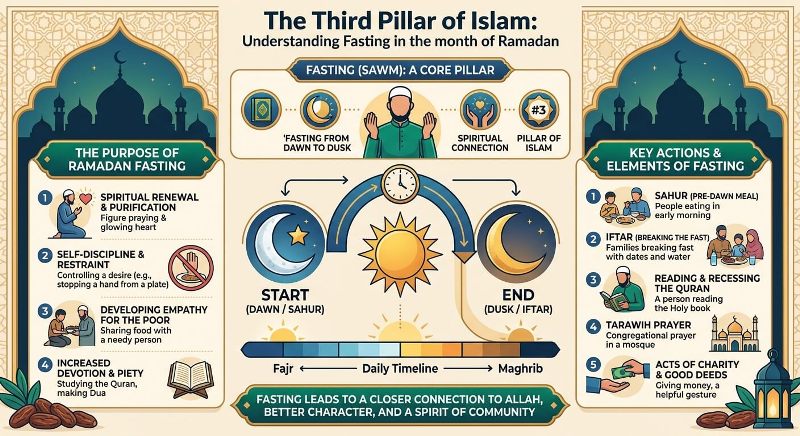
Every year, over 1.8 billion Muslims around the world embrace one of the most spiritually transformative acts of worship in Islam — Sawm (fasting) during the blessed month of Ramadan. It is not merely about abstaining from food and drink — it is a complete spiritual journey of self-discipline, gratitude, devotion, and closeness to Allah.
Sawm is the third pillar of Islam and one of the most beloved acts of worship in the sight of Allah — so beloved, in fact, that Allah Himself declared that He will personally reward those who fast sincerely.
In this guide, we explore the meaning, definition, Quranic evidence, and incredible merits of fasting in Islam.
What is the Third Pillar of Islam?
The third pillar of Islam is Siyam (Sawm) — the obligatory fasting observed during the holy month of Ramadan, the ninth month of the Islamic lunar calendar.
Quick Reference Card
| Detail | Info |
| Pillar Number | Third Pillar of Islam |
| Arabic Name | Siyam / Sawm (صَوْم) |
| When | Month of Ramadan (9th Islamic month) |
| Duration | From Fajr (dawn) to Maghrib (sunset) |
| Who Must Fast | Every adult Muslim (male & female) |
| Key Quranic Reference | Surah Al-Baqarah (2:183) |
| Primary Purpose | Achieving Taqwa (God-consciousness) |
What Does the Qur’an Say About Fasting?
Allah (Subhanahu Wa Ta’ala) directly commands fasting in the Holy Qur’an with one of the most well-known and powerful verses in Islam:
Quranic Verse — The Command to Fast
يَا أَيُّهَا الَّذِينَ آمَنُوا كُتِبَ عَلَيْكُمُ الصِّيَامُ كَمَا كُتِبَ عَلَى الَّذِينَ مِن قَبْلِكُمْ لَعَلَّكُمْ تَتَّقُونَ
“O you who believe! Fasting is prescribed for you as it was prescribed for those before you, so that you may achieve Taqwa (God-consciousness).” — Surah Al-Baqarah (2:183)
Key Insights From This Verse:
- “O you who believe!” — Allah addresses the believers directly, making fasting a personal call to every Muslim
- “Fasting is prescribed for you” — this is not optional; it is an obligatory act of worship
- “As it was prescribed for those before you” — fasting is not new to Islam; it was also prescribed to previous nations and prophets
- “So that you may achieve Taqwa” — the ultimate goal of fasting is Taqwa — a heightened awareness, love, and fear of Allah in every moment of life
What is the Definition of Fasting (Siyam) in Islam?
Siyam (Sawm) is defined in Islam as:
“Worshipping Allah by intentionally abstaining from food, drink, sexual intercourse, and all other things that break the fast — from the time of Fajr (dawn) until Maghrib (sunset) — with the sincere intention of pleasing Allah.”
The key word here is intention (Niyyah). Fasting without the intention of worshipping Allah is simply hunger — not an act of worship. The intention is what transforms this physical act into a deeply spiritual one.
What Breaks the Fast? — Things to Avoid During Siyam
During the fast, Muslims must abstain from the following:
| Category | What to Avoid |
| Food & Drink | Eating, drinking, or consuming anything (including water) |
| Intimate Relations | Sexual intercourse between spouses during fasting hours |
| Smoking | All forms of smoking and vaping |
| Injections | Nutritional injections or drips (scholars’ opinions vary) |
| Bad Character | Lying, backbiting, arguing, and sinful speech |
The Prophet Muhammad ﷺ said:
“Whoever does not give up false speech and acting upon it, Allah has no need of him giving up his food and drink.” — [Sahih Al-Bukhari]
This reminds us that Ramadan is not just about physical restraint — it is about moral and spiritual purification as well.
The Merits of Fasting — What Makes Sawm So Special?
The Greatest Hadith on the Merits of Fasting
Abu Hurayrah (RA) reported that the Messenger of Allah ﷺ said:
Arabic:
“كُلُّ عَمَلِ ابْنِ آدَمَ يُضَاعَفُ الْحَسَنَةُ عَشْرُ أَمْثَالِهَا إِلَى سَبْعِمِائَةِ ضِعْفٍ، قَالَ اللَّهُ عَزَّ وَجَلَّ: إِلَّا الصَّوْمَ فَإِنَّهُ لِي وَأَنَا أَجْزِي بِهِ”
Meaning in English:
“Every good deed of the son of Adam is multiplied in reward — from 10 to 700 times — according to one’s intention and sincerity. But Allah (SWT) proclaims: ‘Except for fasting — for it is for Me, and I will personally grant its reward. He leaves his desires and his food for My sake.’ The fasting person has two moments of joy: one when he breaks his fast, and the other when he meets his Lord. And the smell that comes from the mouth of the fasting person is more pleasant to Allah than the fragrance of musk.” — [Collected by Al-Bukhari & Muslim]
Breaking Down This Extraordinary Hadith
This single Hadith contains four extraordinary merits of fasting that make it unlike any other act of worship:
Merit 1 — Fasting is Personally Rewarded by Allah
Every good deed a Muslim performs earns between 10 and 700 times its reward — this is already an incredible blessing. But fasting is in a category entirely of its own:
“Except for fasting — for it is for Me, and I will personally grant its reward.”
Allah does not assign a fixed multiplier to fasting — He personally takes ownership of its reward. This means the reward for sincere fasting is beyond human calculation and imagination — only Allah knows its true value.
Merit 2 — Fasting is an Act of Pure Sincerity (Ikhlas)
Allah says: “He leaves his desires and his food for My sake.”
This is why fasting holds such an elevated status — it is the most sincere act of worship a Muslim can perform. Unlike Salah or Zakat, which can be seen by others, fasting is completely between the servant and Allah. No one can truly verify whether a person is fasting — only Allah knows. This makes it the purest expression of Ikhlas (sincerity).
Merit 3 — Two Moments of Incomparable Joy
The Prophet ﷺ tells us that the fasting person experiences two unique moments of pure joy:
| Moment of Joy | When It Happens | What It Means |
| First Joy | When breaking the fast (Iftar) | The relief, gratitude, and blessing of breaking the fast after a day of worship |
| Second Joy | When meeting Allah on the Day of Judgment | The ultimate, eternal joy of seeing Allah’s pleasure for the fasting done in this world |
The first joy is a taste of blessing in this world. The second joy is the reward of the Hereafter — and it is incomparably greater.
Merit 4 — The Blessed Smell of the Fasting Person
“The smell that comes from the mouth of the fasting person is more pleasant to Allah than the fragrance of musk.”
Musk is considered the finest and most precious fragrance in the Islamic tradition. Yet Allah considers the breath of a fasting person — which may seem unpleasant to people — to be even more beloved to Him. This is because it is a physical sign of worship and sacrifice done purely for His sake.
Additional Merits of Fasting in Ramadan
Beyond this extraordinary Hadith, fasting in Ramadan carries many more incredible blessings:
- Gates of Paradise are opened — the Prophet ﷺ said that in Ramadan, the gates of Jannah are flung open
- Gates of Hellfire are closed — the gates of Jahannam are shut throughout Ramadan
- Shayateen are chained — the devils are restrained, making it easier to worship and avoid sin
- Laylatul Qadr — the Night of Power, hidden in the last 10 nights of Ramadan, is better than 1,000 months of worship
- Complete forgiveness of past sins — the Prophet ﷺ said whoever fasts Ramadan with faith and seeking reward will have their past sins forgiven
- Spiritual detox — Ramadan purifies the heart, resets habits, and renews a Muslim’s commitment to Allah
- Empathy for the poor — experiencing hunger builds compassion and gratitude for Allah’s blessings
Who is Exempt From Fasting?
Islam is a religion of mercy. The following people are exempt from fasting under certain conditions:
| Category | Ruling |
| Travelers | May break fast and make up the days later |
| Sick individuals | May break fast and make up days when recovered |
| Pregnant women | May break fast if fasting poses a risk |
| Breastfeeding mothers | May break fast if needed |
| Elderly (unable to fast) | May pay Fidyah (feeding a poor person per day) instead |
| Menstruating women | Must break fast and make up the missed days later |
Allah says in the Qur’an:
“Allah intends ease for you and does not intend hardship for you.” — Surah Al-Baqarah (2:185)
The Spiritual Purpose of Fasting — Achieving Taqwa
The Qur’an tells us the ultimate goal of fasting is Taqwa — but what exactly is Taqwa?
Taqwa can be defined as:
“A state of the heart in which a person is constantly aware of Allah, fears His displeasure, loves His pleasure, and guards themselves against sin — in every moment of their life.”
Fasting builds Taqwa because it:
- Trains the self-control needed to resist sin
- Increases awareness of Allah throughout every hour of the day
- Strengthens the willpower to choose obedience over desire
- Reminds the believer that Allah is always watching — even when no one else is
Summary — Merits of Fasting at a Glance
| Merit | Evidence |
| Personally rewarded by Allah | Hadith (Bukhari & Muslim) |
| Purest act of sincerity (Ikhlas) | Hadith (Bukhari & Muslim) |
| Two moments of joy | Hadith (Bukhari & Muslim) |
| Breath more beloved than musk | Hadith (Bukhari & Muslim) |
| Past sins forgiven | Hadith (Bukhari & Muslim) |
| Gates of Jannah opened | Hadith (Bukhari & Muslim) |
| Achieves Taqwa | Surah Al-Baqarah (2:183) |
| Laylatul Qadr — 1,000 months of reward | Surah Al-Qadr (97:3) |
Conclusion
Sawm (fasting) is one of the most powerful and beloved acts of worship a Muslim can perform. It is the third pillar of Islam — a pillar that purifies the soul, strengthens the heart, builds Taqwa, and earns a reward that only Allah Himself can measure.
As Allah proclaimed in the Hadith Qudsi: “Fasting is for Me, and I will personally grant its reward.” — there is no greater motivation for a Muslim to embrace Ramadan with full sincerity, dedication, and joy.
May Allah (Subhanahu Wa Ta’ala) allow us to witness many Ramadans, accept our fasting with the highest reward, purify our hearts, forgive all our sins, and make us among the people of Taqwa. May He, by His infinite Mercy, grant us all entry into Jannah. Ameen, Ya Rabbal ‘Alameen.
Jazakallahu Khayran!
Tags: third pillar of Islam, Sawm in Islam, Siyam meaning in English, fasting in Ramadan, importance of fasting in Islam, merits of fasting hadith, Surah Al-Baqarah 2:183, Taqwa meaning, Ramadan fasting rules, what breaks the fast in Islam, who is exempt from fasting
