Introduction
In Islam, a greeting is never just a greeting. When a Muslim says “Assalamu Alaikum” to you, they are gifting you a du’a (supplication) — a heartfelt prayer asking Allah to bestow His peace upon you. And when you respond with “Wa Alaikum Salam”, you are returning that gift — and earning your own divine reward in the process.
Wa Alaikum Salam (وَعَلَيْكُم ٱلسَّلَامُ) is the Islamic response to the greeting of Salam — and just like the greeting itself, it is an act of worship, a Sunnah of the Prophet ﷺ, and an obligation upon every Muslim who hears the Salam.
Allah (SWT) says in the Qur’an:
“When you are greeted with a greeting, respond with a better one or at least return it equally. Indeed, Allah keeps account of all things.” — Surah An-Nisa (4:86)
This verse makes it clear — responding to Salam is not optional. It is a divine command from Allah. In this guide, we explore the meaning, Arabic text, three forms, rewards, and complete etiquette of responding to the Islamic greeting.
What Does Wa Alaikum Salam Mean?
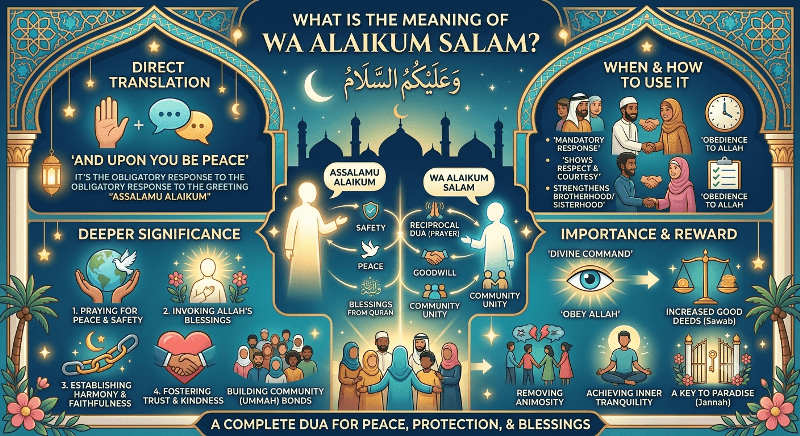
Wa Alaikum Salam (وَعَلَيْكُم ٱلسَّلَامُ) is the standard Islamic response to the greeting of Assalamu Alaikum. It means:
“And upon you be peace.”
The word “Wa” (وَ) means “and” — meaning the respondent is returning the same peace back to the greeter. It is a beautiful exchange where both parties walk away having received a du’a from each other.
The Name Behind the Response — As-Salam
Just like the greeting, the response is rooted in one of the 99 Beautiful Names of Allah:
| Detail | Info |
| As-Salam (السَّلَام) | One of the 99 Names of Allah — The Source of Peace |
| What the response means | “May Allah’s peace also be upon you” |
| Type of act | Obligatory (Fard Kifayah) — a communal duty |
| Quranic Command | Surah An-Nisa (4:86) |
| Best form | Complete form — Wa Alaikum Salam Warahmatullahi Wabarakatuhu |
The 3 Forms of Wa Alaikum Salam — Matching the Greeting
Islam has established three forms of response — each one corresponding to the level of the greeting received. The rule is simple: always respond with an equal or better greeting.
Form 1: Wa Alaikum Salam (Basic Response)
وَعَلَيْكُمُ السَّلَامُ
Transliteration: Wa Alaikum Salam Meaning in English: “And peace be upon you.” When to use: In response to “Assalamu Alaikum” Reward: 10 good deeds (Hasanat)
This is the minimum valid response to the Islamic greeting. It is simple, sincere, and fully rewarded by Allah.
Form 2: Wa Alaikum Salam Warahmatullah (Intermediate Response)
وَعَلَيْكُمُ السَّلَامُ وَرَحْمَةُ اللهِ
Transliteration: Wa Alaikum Salam Warahmatullah Meaning in English: “And peace and the mercy of Allah be upon you.” When to use: In response to “Assalamu Alaikum Warahmatullah” Reward: 20 good deeds (Hasanat)
By adding “Warahmatullah” — and the mercy of Allah — this response elevates the exchange with a prayer for Allah’s special mercy upon the greeter.
Form 3: Wa Alaikum Salam Warahmatullahi Wabarakatuhu (Complete Response)
وَعَلَيْكُمُ السَّلَامُ وَرَحْمَةُ اللهِ وَبَرَكَاتُهُ
Transliteration: Wa Alaikum Salam Warahmatullahi Wabarakatuhu Meaning in English: “And peace, mercy, and blessings of Allah be upon you.” When to use: In response to “Assalamu Alaikum Warahmatullahi Wabarakatuhu” Reward: 30 good deeds (Hasanat)
This is the most complete, most rewarded, and most beloved form of the Islamic response. It encompasses three divine gifts — peace, mercy, and blessings — all returned to the one who greeted you.
Pro Tip: Even if someone greets you with just “Assalamu Alaikum”, you can always respond with the complete form — “Wa Alaikum Salam Warahmatullahi Wabarakatuhu” — and earn the maximum reward of 30 good deeds while also giving the greeter a better response than they gave you.
Word-by-Word Breakdown of the Complete Response
| Arabic | Transliteration | Meaning |
| وَ | Wa | And |
| عَلَيْكُمُ | Alaikum | Upon you |
| السَّلَامُ | As-Salamu | The Peace (name of Allah) |
| وَرَحْمَةُ | Wa Rahmatu | And the mercy of |
| اللهِ | Allah | Allah |
| وَبَرَكَاتُهُ | Wa Barakatuhu | And His blessings |
Full meaning: “And upon you be the Peace of Allah, His Mercy, and His Blessings.”
All 3 Forms — Complete Greeting & Response Guide
| # | Greeting (Salam) | Response (Wa Alaikum Salam) | Reward |
| 1 | اَلسَّلَامُ عَلَيْكُمْ | وَعَلَيْكُمُ السَّلَامُ | 10 good deeds |
| Assalamu Alaikum | Wa Alaikum Salam | ||
| 2 | اَلسَّلَامُ عَلَيْكُمْ وَرَحْمَةُ اللهِ | وَعَلَيْكُمُ السَّلَامُ وَرَحْمَةُ اللهِ | 20 good deeds |
| Assalamu Alaikum Warahmatullah | Wa Alaikum Salam Warahmatullah | ||
| 3 | اَلسَّلَامُ عَلَيْكُمْ وَرَحْمَةُ اللهِ وَبَرَكَاتُهُ | وَعَلَيْكُمُ السَّلَامُ وَرَحْمَةُ اللهِ وَبَرَكَاتُهُ | 30 good deeds |
| Assalamu Alaikum Warahmatullahi Wabarakatuhu | Wa Alaikum Salam Warahmatullahi Wabarakatuhu |
What is the Benefit of Saying and Responding to Salam?
The Hadith That Defines Its Importance
Abdullah ibn Amr (RA) narrated:
“A man asked the Messenger of Allah ﷺ: ‘Which act in Islam is the best?’ The Prophet ﷺ replied: ‘To give food, and to give the Salam to everyone — whether you know them or not.’” — [Collected by Al-Bukhari & Muslim]
This powerful Hadith reveals why the exchange of Salam is so highly valued in Islam:
- It is one of the best acts in all of Islam — ranked alongside feeding others
- It should be given to everyone — acquaintances and strangers alike
- Both greeting and responding are acts of worship that earn divine reward
The Hadith on the Power of Spreading Salam
The Prophet ﷺ also said:
“You will not enter Paradise until you believe, and you will not believe until you love one another. Shall I not tell you of something that, if you do it, you will love one another? Spread the Salam amongst yourselves.” — [Sahih Muslim]
This Hadith draws a direct line from Salam → Love → Iman → Jannah. The simple act of greeting and responding to Salam is literally a path to Paradise.
Spiritual & Social Benefits of Responding to Salam
Spiritual Benefits:
- Earns 10 to 30 good deeds with every single response
- Fulfills a Quranic obligation — commanded in Surah An-Nisa (4:86)
- Follows the Sunnah of the Prophet Muhammad ﷺ
- Returns a du’a — the respondent receives and gives a prayer simultaneously
- One of the best acts in Islam — confirmed in Sahih Al-Bukhari & Muslim
- Earns Allah’s pleasure through every sincere exchange of Salam
Social & Community Benefits:
- Generates mutual love between Muslims
- Removes hatred, envy, and ill-will from hearts
- Strengthens the bonds of the Ummah — one universal exchange connecting all Muslims
- Creates an atmosphere of warmth and security in homes, masajid, and communities
- Breaks social barriers — responding to a stranger’s Salam opens hearts and builds brotherhood
- Reflects the mercy and peace of Allah in every human interaction
Important Rules & Etiquette of Responding to Salam
Every Muslim should know the key rules surrounding the Islamic greeting and its response:
| Rule | Detail |
| Responding is obligatory | If one person in a group responds, the obligation is fulfilled for all (Fard Kifayah) |
| Respond with equal or better | Always match or exceed the form of the greeting received |
| Best response always | You may always respond with the complete form regardless of what was said |
| Responding to non-Muslims | If a non-Muslim says Salam to you, respond with “Wa Alaikum” only |
| Written Salam | If you receive a written Salam (letter, message), it is obligatory to respond |
| No substitute | No nod, wave, or other gesture can replace the verbal response to Salam |
| Timing | Respond immediately — delaying the response without reason is disliked |
When is It Sunnah to Say Wa Alaikum Salam?
The response of Wa Alaikum Salam is said in all the same situations where Salam is exchanged:
| Situation | Response |
| When meeting a Muslim | Respond immediately with Wa Alaikum Salam |
| When entering a gathering | If greeted, respond to every Salam given |
| On the phone | Respond to Salam at the beginning of every call |
| When someone leaves | Return their farewell Salam warmly |
| In messages and letters | Respond in writing to any written Salam |
| After Salah (Tasleem) | The Tasleem at the end of Salah is a form of Salam to the angels |
Why Responding to Salam is a Unique Act of Worship
What makes the Islamic exchange of Salam truly unique is that it is simultaneously:
| Aspect | Explanation |
| An act of worship | Both greeting and responding earn divine rewards |
| A du’a for others | You are praying for the peace of the person you respond to |
| A social bond | It creates love, warmth, and unity in the community |
| A Quranic obligation | Allah commands us to respond in Surah An-Nisa (4:86) |
| A Sunnah of the Prophet ﷺ | The Prophet ﷺ consistently greeted and responded to Salam |
| A path to Jannah | Spreading Salam leads to love, which leads to Iman, which leads to Paradise |
No other greeting in the world carries this combination of spiritual, social, and eternal significance.
Quick Reference Card — Wa Alaikum Salam
| Detail | Info |
| Arabic (Complete) | وَعَلَيْكُمُ السَّلَامُ وَرَحْمَةُ اللهِ وَبَرَكَاتُهُ |
| Transliteration | Wa Alaikum Salam Warahmatullahi Wabarakatuhu |
| Meaning | And peace, mercy, and blessings of Allah be upon you |
| Best Form | Complete form — 30 good deeds per response |
| Obligation | Fard Kifayah — obligatory to respond |
| Quranic Reference | Surah An-Nisa (4:86) |
| Key Hadith | “Spread Salam amongst yourselves” (Sahih Muslim) |
Conclusion
Wa Alaikum Salam is far more than a polite reply — it is a divine obligation, a Sunnah, a du’a, and a deed that earns the pleasure of Allah — all wrapped into a few beautiful words.
Every time you respond to a Salam, you are:
- Obeying a command from Allah in the Qur’an
- Following the Sunnah of the Prophet ﷺ
- Earning 10 to 30 good deeds in seconds
- Returning a prayer of peace and mercy to a fellow Muslim
- Taking a step on the path that leads to Jannah
So the next time you hear “Assalamu Alaikum” — respond with full sincerity, full warmth, and the complete, beautiful words:
وَعَلَيْكُمُ السَّلَامُ وَرَحْمَةُ اللهِ وَبَرَكَاتُهُ
Wa Alaikum Salam Warahmatullahi Wabarakatuhu
May Allah (SWT) accept all our good deeds, fill our hearts with love for one another, make us consistent in following the Sunnah, forgive our shortcomings, and make us among the people of Taqwa. May He, by His infinite Mercy, grant us all entry into Jannah. Ameen, Ya Rabbal ‘Alameen.
Jazakallahu Khayran!
Tags: Wa Alaikum Salam meaning, Wa Alaikum Salam Warahmatullahi Wabarakatuhu meaning, how to respond to Assalamu Alaikum, Islamic greeting response, 3 forms of Wa Alaikum Salam, benefits of saying Salam in Islam, Surah An-Nisa 4:86, Islamic etiquette of greeting, Salam in Islam, Sunnah of greeting in Islam
