Introduction
Five times every day — from the minarets of mosques across the world — a powerful, melodious call rises into the air, piercing through the noise of daily life and summoning the hearts of believers back to their Creator:
اللهُ أَكْبَرُ — اللهُ أَكْبَرُ
“Allahu Akbar — Allah is the Greatest.”
This is the Adhan — the Islamic call to prayer — one of the most recognizable and spiritually stirring sounds on earth. For over 1,400 years, the Adhan has been calling Muslims away from the distractions of this world and directing their hearts, minds, and bodies toward Allah.
In this comprehensive guide, we explore the meaning, Islamic ruling, merits, complete words, and the powerful duas associated with the Adhan.
What is the Adhan?
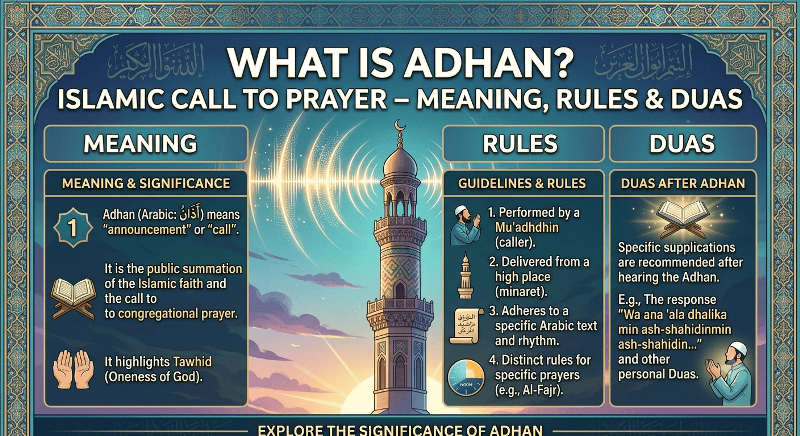
Adhan (أَذَان) is the Islamic call to prayer — a vocal announcement delivered five times a day by a Mu’adhin (مُؤَذِّن) — the person designated to call Muslims to prayer. It serves as both a reminder and an invitation — calling believers to leave behind their worldly affairs and turn toward Salah (prayer).
Quick Reference Card
| Detail | Info |
| Arabic Name | Adhan (أَذَان) |
| Literal Meaning | Announcement / Proclamation |
| Purpose | Call Muslims to the five daily prayers |
| Who Delivers It | Mu’adhin (مُؤَذِّن) — the caller to prayer |
| Frequency | Five times daily |
| Islamic Ruling | Fard Kifayah (Collective Obligatory Duty) |
| Special Addition | Fajr Adhan includes “As-Salaatu Khairun Minan-Naum” |
| Key Hadith | Sahih Al-Bukhari — every creation witnesses for the Mu’adhin |
What is the Islamic Ruling on Adhan?
The Adhan carries a specific and important Islamic ruling:
Adhan is Fard Kifayah — a collective obligatory duty upon the Muslim community.
This means:
- If at least one person in the community calls the Adhan, the obligation is fulfilled for everyone
- If no one calls the Adhan in a community, the entire community has sinned
This ruling reflects the immense importance of the Adhan in Islam — it is not a mere tradition or optional practice. It is a communal religious duty that must be upheld in every Muslim community, in every city, in every era.
The Merits of Adhan — Why the Mu’adhin is So Honored
The Extraordinary Hadith on the Reward of the Adhan
Abu Sa’eed Al-Khudri (RA) said: I heard the Messenger of Allah ﷺ say:
Arabic:
“لَا يَسْمَعُ مَدَى صَوْتِ الْمُؤَذِّنِ جِنٌّ وَلَا إِنْسٌ وَلَا شَيْءٌ إِلَّا شَهِدَ لَهُ يَوْمَ الْقِيَامَةِ”
Meaning in English:
“No one hears the most distant voice of the Mu’adhin — whether jinn, human beings, or any other creation — except that they shall be a witness for him on Yawm Al-Qiyamah (the Day of Resurrection).” — [Collected by Al-Bukhari]
The Power of This Hadith
This single Hadith reveals something truly breathtaking about the Adhan:
- Every living creation that hears the Adhan — human, jinn, animal, tree, stone — becomes a witness for the Mu’adhin on the Day of Judgment
- The further the voice of the Adhan travels, the more witnesses the Mu’adhin gains
- This means every Adhan called with sincerity is building an army of witnesses for the caller before Allah on the most important Day of all
The Prophet ﷺ also said:
“The Mu’adhineen will have the longest necks on the Day of Resurrection.” — [Sahih Muslim]
This is a sign of honor and distinction — the Mu’adhineen will be among the most recognizable and elevated people on the Day of Judgment.
How the Adhan is Made — Complete Words, Arabic & Meaning
The Adhan consists of specific phrases repeated a set number of times. Here is the complete Adhan with Arabic text, transliteration, meaning, and repetitions:
Step 1 — Allahu Akbar (×4)
اللهُ أَكْبَرُ — اللهُ أَكْبَرُ
اللهُ أَكْبَرُ — اللهُ أَكْبَرُ
Transliteration: Allahu Akbar (4 times)
Meaning: “Allah is the Greatest — Allah is the Greatest.”
This powerful opening declaration announces to the world that Allah is greater than everything — greater than sleep, greater than work, greater than any worldly concern.
Step 2 — Ash-hadu an laa ilaaha illallah (×2)
أَشْهَدُ أَنْ لَا إِلَٰهَ إِلَّا اللهُ
أَشْهَدُ أَنْ لَا إِلَٰهَ إِلَّا اللهُ
Transliteration: Ash-hadu an laa ilaaha illallah (2 times)
Meaning: “I testify that there is no god worthy of worship except Allah.”
This is the first part of the Shahadah — the declaration of Tawheed (Oneness of Allah) — proclaimed publicly for all to hear.
Step 3 — Ash-hadu anna Muhammadan Rasulullah (×2)
أَشْهَدُ أَنَّ مُحَمَّدًا رَسُولُ اللهِ
أَشْهَدُ أَنَّ مُحَمَّدًا رَسُولُ اللهِ
Transliteration: Ash-hadu anna Muhammadan Rasulullah (2 times)
Meaning: “I testify that Muhammad ﷺ is the Messenger of Allah.”
This is the second part of the Shahadah — proclaiming the Prophethood of Muhammad ﷺ to the entire community.
Step 4 — Hayya ‘alas-Salaah (×2)
حَيَّ عَلَى الصَّلَاةِ
حَيَّ عَلَى الصَّلَاةِ
Transliteration: Hayya ‘alas-Salaah (2 times)
Meaning: “Hurry towards Salah — Hurry towards Salah.”
This is the direct invitation — the Mu’adhin is calling every Muslim to stop what they are doing and come to prayer.
Step 5 — Hayya ‘alal-Falaah (×2)
حَيَّ عَلَى الْفَلَاحِ
حَيَّ عَلَى الْفَلَاحِ
Transliteration: Hayya ‘alal-Falaah (2 times)
Meaning: “Hurry towards success — Hurry towards success.”
This phrase is profound — it defines Salah as success. True success in Islam is not wealth or status — it is standing before Allah in prayer.
Step 6 — Allahu Akbar (×2)
اللهُ أَكْبَرُ — اللهُ أَكْبَرُ
Transliteration: Allahu Akbar (2 times)
Meaning: “Allah is the Greatest — Allah is the Greatest.”
Step 7 — Laa ilaaha illallah (×1)
لَا إِلَٰهَ إِلَّا اللهُ
Transliteration: Laa ilaaha illallah (1 time)
Meaning: “There is no god worthy of worship except Allah.”
The Adhan closes as it began — with the declaration of Tawheed — reminding every listener that all of life returns to the Oneness of Allah.
The Complete Adhan — Quick Reference Table
| # | Arabic | Transliteration | Meaning | Times |
| 1 | اللهُ أَكْبَرُ | Allahu Akbar | Allah is the Greatest | ×4 |
| 2 | أَشْهَدُ أَنْ لَا إِلَٰهَ إِلَّا اللهُ | Ash-hadu an laa ilaaha illallah | I testify none is worthy of worship except Allah | ×2 |
| 3 | أَشْهَدُ أَنَّ مُحَمَّدًا رَسُولُ اللهِ | Ash-hadu anna Muhammadan Rasulullah | I testify Muhammad ﷺ is the Messenger of Allah | ×2 |
| 4 | حَيَّ عَلَى الصَّلَاةِ | Hayya ‘alas-Salaah | Hurry towards Salah | ×2 |
| 5 | حَيَّ عَلَى الْفَلَاحِ | Hayya ‘alal-Falaah | Hurry towards success | ×2 |
| 6 | اللهُ أَكْبَرُ | Allahu Akbar | Allah is the Greatest | ×2 |
| 7 | لَا إِلَٰهَ إِلَّا اللهُ | Laa ilaaha illallah | None is worthy of worship except Allah | ×1 |
Special Addition for Fajr Adhan — As-Salaatu Khairun Minan-Naum
The Fajr (dawn) Adhan has a special addition that is not found in any other Adhan. After “Hayya ‘alal-Falaah”, the Mu’adhin adds:
الصَّلَاةُ خَيْرٌ مِنَ النَّوْمِ
الصَّلَاةُ خَيْرٌ مِنَ النَّوْمِ
Transliteration: As-Salaatu Khairun Minan-Naum (2 times)
Meaning: “Salah is better than sleep — Salah is better than sleep.”
This beautiful addition is specific to the Fajr Adhan — a gentle but firm reminder that rising for the dawn prayer is more valuable than the comfort of sleep. It is a Sunnah of the Prophet ﷺ and has been called since the earliest days of Islam.
How to Repeat the Adhan with the Mu’adhin
It is a recommended Sunnah to repeat the words of the Adhan along with the Mu’adhin as you hear it. However, there is one important exception:
Important Note — What to Say During “Hayya ‘alas-Salaah” and “Hayya ‘alal-Falaah”
When the Mu’adhin says “Hayya ‘alas-Salaah” and “Hayya ‘alal-Falaah”, do not repeat these words. Instead, say:
لَا حَوْلَ وَلَا قُوَّةَ إِلَّا بِاللهِ
Transliteration: La Hawla Wa La Quwwata Illa Billah
Meaning: “There is no power nor ability except by Allah.”
Why This Replacement?
When the Mu’adhin calls “Hurry to prayer” and “Hurry to success”, the listener responds by acknowledging that they have no power to obey except through Allah’s help. This is a beautiful expression of complete tawakkul (reliance on Allah) — recognizing that even our ability to respond to the call to prayer is a gift from Allah.
Complete Guide to Repeating the Adhan
| Adhan Words | What the Listener Says |
| Allahu Akbar | Allahu Akbar (repeat) |
| Ash-hadu an laa ilaaha illallah | Ash-hadu an laa ilaaha illallah (repeat) |
| Ash-hadu anna Muhammadan Rasulullah | Ash-hadu anna Muhammadan Rasulullah (repeat) |
| Hayya ‘alas-Salaah | La Hawla Wa La Quwwata Illa Billah |
| Hayya ‘alal-Falaah | La Hawla Wa La Quwwata Illa Billah |
| Allahu Akbar | Allahu Akbar (repeat) |
| Laa ilaaha illallah | Laa ilaaha illallah (repeat) |
Dua After the Adhan — Two Powerful Supplications
The time after the Adhan is one of the most blessed and powerful moments for du’a in Islam. Every Muslim should take full advantage of this sacred window.
Dua 1 — The Dua for the Prophet ﷺ After Adhan
Jabir (RA) reported that the Messenger of Allah ﷺ said:
Arabic:
“اللَّهُمَّ رَبَّ هَذِهِ الدَّعْوَةِ التَّامَّةِ وَالصَّلَاةِ الْقَائِمَةِ آتِ مُحَمَّدًا الْوَسِيلَةَ وَالْفَضِيلَةَ وَابْعَثْهُ مَقَامًا مَحْمُودًا الَّذِي وَعَدْتَهُ”
Transliteration:
“Allahumma Rabba hadhihid-da’watit-tammati was-salatil-qa’imati, ati Muhammadanil-waseelata wal-fadeelata, wab’ath-hu maqamam-mahmuda nil-ladhi wa’adtahu.”
Meaning in English:
“O Allah, Lord of this perfect call and the established prayer — grant Muhammad ﷺ intercession and honor, and raise him to the praised position (Al-Maqam Al-Mahmud) that You promised him.” — [Collected by Al-Bukhari]
The Reward of This Dua
The Prophet ﷺ said:
“Whoever says this du’a after hearing the Adhan becomes eligible for my intercession on the Day of Judgment.” — [Sahih Al-Bukhari]
This is one of the most powerful promises in Islam — reciting this simple du’a after every Adhan earns the intercession of the Prophet ﷺ on the Day of Judgment. There is no greater advocate on that day than the Messenger of Allah ﷺ.
Dua 2 — The Time Between Adhan and Iqamah
Anas ibn Malik (RA) reported that the Messenger of Allah ﷺ said:
Arabic:
“الدُّعَاءُ لَا يُرَدُّ بَيْنَ الْأَذَانِ وَالْإِقَامَةِ”
Meaning in English:
“Du’a is never turned down between the Adhan and the Iqamah.” — [Collected by At-Tirmidhi & Abu Dawud]
The Golden Window of Du’a
The time between the Adhan and the Iqamah is one of the most precious, guaranteed windows for answered du’a in the entire Islamic calendar. Every Muslim should use this time to:
- Make personal du’a for themselves and their loved ones
- Ask Allah for forgiveness, health, and guidance
- Pray for the Muslim Ummah
- Make any sincere supplication — knowing it will not be rejected
Benefits & Wisdom of the Adhan — Why It Is So Powerful
The Adhan is not just a call to prayer — it is a complete spiritual system with profound benefits for the individual and the community:
Spiritual Benefits:
- Declares the greatness of Allah publicly — five times every day
- Proclaims the Shahadah to the entire community and all of creation
- Redirects hearts from the dunya to what truly matters — Allah and prayer
- Every creation that hears it witnesses for the Mu’adhin on the Day of Judgment
- Earns immense reward for the Mu’adhin — one of the most honored roles in Islam
- Opens a guaranteed window of answered du’a between the Adhan and Iqamah
Community Benefits:
- Unites the Muslim community — calling everyone to gather at the same time
- Maintains the Islamic identity of a community — the Adhan marks a Muslim neighborhood
- Reminds all of creation of Allah’s greatness — jinn, humans, animals, and all else
- Preserves the five daily prayers as a communal practice throughout generations
- Establishes the times of prayer publicly — so no Muslim misses their Salah
The Adhan at a Glance — Summary Table
| Aspect | Detail |
| What is it? | Islamic call to the five daily prayers |
| Who calls it? | Mu’adhin — designated caller to prayer |
| Islamic ruling | Fard Kifayah — collective community obligation |
| Phrases | 7 distinct phrases — specific repetitions |
| Special Fajr addition | “Salah is better than sleep” (×2) |
| Listener’s response | Repeat after Mu’adhin (with exception for Hayya phrases) |
| Exception | Say “La Hawla Wa La Quwwata Illa Billah” for Hayya phrases |
| Dua after Adhan | Specific du’a earning intercession of the Prophet ﷺ |
| Best time for du’a | Between Adhan and Iqamah — du’a is never rejected |
| Greatest merit | Every creation that hears it witnesses for the Mu’adhin on Judgment Day |
Conclusion
The Adhan is one of the most magnificent gifts Allah has given to the Muslim Ummah. Five times every day, it cuts through the noise and distractions of this world and reminds every believer of the one truth that never changes:
اللهُ أَكْبَرُ
“Allah is the Greatest.”
Whether you are the one calling the Adhan, repeating it as you hear it, or pausing your day to make du’a in the sacred window between the Adhan and Iqamah — every moment connected to the Adhan is a moment of worship, reward, and closeness to Allah.
The next time you hear the Adhan, pause, repeat its words, recite the du’a of the Prophet ﷺ, and use the blessed window before the Iqamah to pour your heart out to Allah — knowing with certainty that your du’a will not be rejected.
May Allah (Subhanahu Wa Ta’ala) guide us all to His truth, purify our intentions, grant us the ability to respond to every Adhan with full devotion, accept all our good deeds, forgive our shortcomings, and make us among the people of Taqwa. May He, by His infinite Mercy, grant us all entry into Jannah. Ameen, Ya Rabbal ‘Alameen.
Jazakallahu Khayran!
Tags: what is Adhan in Islam, Adhan meaning in English, how Adhan is made, words of Adhan in Arabic, merits of Adhan, dua after Adhan, Fajr Adhan special addition, repeating Adhan with Muadhin, La Hawla Wa La Quwwata Illa Billah, dua between Adhan and Iqamah, Islamic call to prayer
