Introduction
Every year, as the crescent moon marks the beginning of Ramadan — the ninth month of the Islamic lunar calendar — over 1.8 billion Muslims around the world make the same profound commitment: to fast from Fajr (dawn) until Maghrib (sunset), every single day, for an entire month.
No food. No drink. No intimate relations. From the first light of dawn until the sun disappears below the horizon — Muslims willingly embrace this act of worship with joy, gratitude, and unwavering devotion.
But why? Why do Muslims fast in Ramadan?
The answer goes far deeper than religious obligation. Fasting in Islam — known as Sawm or Siyam — is a complete system of spiritual, social, physical, and psychological transformation. It was prescribed by Allah (SWT) not to punish believers, but to elevate them — in faith, in character, in health, and in their relationship with their Creator.
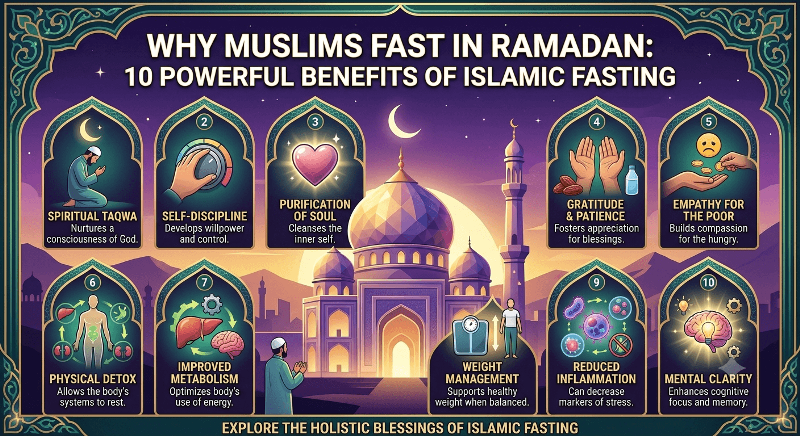
In this article, we explore the 10 most powerful benefits of Islamic fasting — backed by the Qur’an, the Sunnah of the Prophet Muhammad ﷺ, and modern science.
Why Do Muslims Fast in Ramadan? — The Quranic Command
Before exploring the benefits, every Muslim must understand the divine reason behind fasting. Allah (SWT) commands it directly in the Holy Qur’an:
“O you who believe! Fasting is prescribed for you as it was prescribed for those before you, so that you may achieve Taqwa (God-consciousness).” — Surah Al-Baqarah (2:183)
This verse reveals the core purpose of fasting — Taqwa. Everything else — the spiritual rewards, the health benefits, the social unity — flows from this single divine goal. Fasting is Allah’s chosen method for developing God-consciousness in the heart of every believer.
10 Powerful Benefits of Fasting in Islam
Benefit 1 — It is the Highest Act of Obedience to Allah
Above every other benefit, fasting is first and foremost an act of pure obedience and submission to Allah. When a Muslim fasts, they are declaring with every moment of hunger and thirst:
“I am doing this for You alone, O Allah.”
This is what makes fasting so uniquely powerful. Unlike Salah, which others can see, or Zakat, which can be measured — fasting is completely between the servant and Allah. No one can truly verify whether a person is fasting except Allah Himself. This makes it the purest expression of sincerity (Ikhlas) in all of Islam.
Allah (SWT) confirmed this in a Hadith Qudsi:
“Every deed of the son of Adam is for himself — except fasting. It is for Me, and I will personally reward it.” — [Sahih Al-Bukhari & Muslim]
Benefit 2 — Fasting Builds Taqwa (God-Consciousness)
Taqwa is the greatest gift a Muslim can carry in their heart — a constant awareness of Allah that guides every thought, word, and action. Fasting is the most powerful builder of Taqwa because it trains the believer to:
- Obey Allah even when no one is watching
- Resist desires and temptations for Allah’s sake
- Remain mindful of Allah throughout every hour of the day
- Choose obedience over comfort consistently
A Muslim who completes Ramadan with sincerity emerges with a stronger, more God-conscious heart — one that is better equipped to resist sin and pursue righteousness for the rest of the year.
Benefit 3 — All Previous Sins Are Forgiven
One of the most breathtaking promises in all of Islam belongs to Ramadan fasting. The Prophet Muhammad ﷺ said:
“Whoever fasts Ramadan out of sincere faith and hoping for its reward from Allah — will have all of his previous sins forgiven.” — [Collected by Al-Bukhari & Muslim]
Imagine completing Ramadan with a completely clean record — every sin wiped away, every mistake forgiven, every regret erased. This is the mercy of Allah at its most magnificent. For this reason alone, every Muslim should approach Ramadan with full sincerity, full faith, and full hope in Allah’s promise.
Benefit 4 — The Gates of Heaven Open & Devils Are Chained
Ramadan is not just spiritually significant — it is cosmically transformed by Allah. The Prophet ﷺ said:
“When Ramadan begins, the gates of the heavens are opened, the gates of Hellfire are closed, and the devils are chained.” — [Collected by Al-Bukhari & Muslim]
This divine transformation makes worship easier, sin harder, and du’a more powerful during Ramadan than at any other time of the year. The entire month is bathed in Allah’s mercy — and fasting is the key that unlocks access to all of it.
Benefit 5 — The Reward is Nothing Less Than Jannah
The Prophet ﷺ described the ultimate reward of sincere fasting with one word:
“Hajj Mabrur (accepted Hajj) has no reward except Jannah — and one Umrah to another erases sins between them.” — [Sahih Al-Bukhari & Muslim]
And specifically about fasting, Allah proclaimed in the Hadith Qudsi that He will personally grant the reward — a reward so immense that no angel records it and no number can contain it. The fasting person also has two moments of incomparable joy: at Iftar in this world, and when meeting Allah on the Day of Judgment.
Benefit 6 — Develops Patience, Discipline & Self-Control
The Prophet ﷺ called Ramadan the “Month of Patience” — and patience (Sabr) is described in the Qur’an as having a reward without limit. Fasting teaches Muslims to:
- Control physical desires — hunger, thirst, and base instincts
- Guard the tongue — from lying, backbiting, and idle speech
- Discipline the mind — resisting anger, negativity, and impatience
- Build endurance — carrying spiritual and physical challenges with grace
These qualities of patience and self-discipline do not disappear after Ramadan — they permanently strengthen the character of every sincere fasting Muslim.
Benefit 7 — Strengthens Muslim Unity and Brotherhood
When the entire global Muslim Ummah — over 1.8 billion people across every race, nation, language, and social class — fasts at the same time, with the same intention, for the same Lord — it creates an extraordinary bond of universal brotherhood and equality unlike anything else in human experience.
In Ramadan, the rich and the poor share the same hunger. The king and the servant stand equally before Allah. This shared experience dissolves social barriers, strengthens community bonds, and reminds every Muslim that they are part of one global family united by faith.
Benefit 8 — Teaches Empathy for the Poor and Needy
By personally experiencing hunger and thirst, fasting Muslims develop a genuine, heartfelt empathy for those who live with these realities every single day. This empathy is not theoretical — it is felt in the body and lived in the moment.
This is why Ramadan consistently produces the highest levels of charitable giving of any month of the year. Muslims give Zakat, Sadaqah, and feed others at Iftar in record numbers — driven by the compassion that fasting naturally cultivates in every sincere believer.
Benefit 9 — Improves Mental Clarity and Psychological Well-Being
Modern neuroscience has confirmed what Islam established 1,400 years ago — that fasting has remarkable effects on the mind:
- Improved focus and concentration — as the body diverts energy away from digestion
- Reduced anxiety and mental noise — through the spiritual calm of Dhikr and Qur’an recitation
- Increased sense of purpose and meaning — knowing every moment of hunger is worship
- Emotional regulation — fasting trains the mind to pause before reacting
- Heightened gratitude — the simple act of breaking fast with water and dates creates profound thankfulness
The psychological benefits of fasting extend well beyond Ramadan — building a more resilient, focused, and emotionally balanced Muslim throughout the year.
Benefit 10 — Remarkable Medical and Physical Benefits
Science has increasingly validated the physical benefits of intermittent fasting — many of which align precisely with Islamic fasting:
- Detoxification — the digestive system rests and eliminates accumulated waste
- Reduced cholesterol — stored fats in the bloodstream are broken down, protecting heart health
- Improved insulin sensitivity — blood sugar levels stabilize, reducing the risk of type 2 diabetes
- Cellular repair (Autophagy) — the body repairs and regenerates damaged cells during fasting
- Weight management — healthy reduction of excess body fat through controlled fasting
- Reduced inflammation — fasting has been shown to lower inflammatory markers in the body
Islamic fasting — from Fajr to Maghrib — provides a natural, divinely prescribed window of intermittent fasting that modern medicine increasingly recognizes as one of the most beneficial practices for long-term health.
Summary — 10 Benefits of Fasting in Islam
| # | Benefit | Category |
| 1 | Highest act of obedience to Allah | Spiritual |
| 2 | Builds Taqwa (God-consciousness) | Spiritual |
| 3 | All previous sins are forgiven | Spiritual |
| 4 | Gates of Heaven open & devils chained | Spiritual |
| 5 | Reward is nothing less than Jannah | Spiritual |
| 6 | Develops patience, discipline & self-control | Personal |
| 7 | Strengthens Muslim unity and brotherhood | Social |
| 8 | Teaches empathy for the poor and needy | Social |
| 9 | Improves mental clarity & psychological well-being | Psychological |
| 10 | Remarkable medical and physical benefits | Medical |
Conclusion
Fasting in Ramadan is not a burden — it is a gift from Allah to every believer. It is a month-long invitation to be better — spiritually stronger, morally purer, physically healthier, and socially more compassionate.
From the forgiveness of all past sins to the personal reward promised by Allah Himself — from the strengthening of Muslim brotherhood to the remarkable benefits for body and mind — there is truly no act of worship that touches every dimension of a Muslim’s life quite like Sawm.
So when Ramadan arrives, embrace it with open arms, a willing heart, and the certainty that every moment of hunger, every prayer in the night, and every sincere intention is being seen, valued, and personally rewarded by Allah — the Most Gracious, the Most Merciful.
May Allah (Subhanahu Wa Ta’ala) allow us to witness many blessed Ramadans, accept our fasting, forgive all our sins, grant us Taqwa, and by His infinite Mercy, make us all Inhabitants of Jannah. Ameen, Ya Rabbal ‘Alameen.
Jazakallahu Khayran!
Tags: why Muslims fast in Ramadan, benefits of fasting in Islam, Islamic fasting benefits, spiritual benefits of Ramadan fasting, medical benefits of fasting Islam, Sawm in Islam, Taqwa through fasting, Ramadan benefits, sins forgiven in Ramadan, fasting and health in Islam
