Introduction
Every year, over 1.8 billion Muslims around the world embrace one of the most spiritually powerful acts of worship in Islam — Siyam (fasting) during the blessed month of Ramadan. But fasting in Islam is far more than simply going without food and drink — it is a complete transformation of the body, mind, and soul.
Siyam is the third pillar of Islam and one of the most beloved acts of worship in the sight of Allah — so beloved that Allah (SWT) declared He will personally reward those who fast sincerely, with a reward beyond any fixed measure or calculation.
In this comprehensive guide, we explore the three powerful Hadiths on fasting, and the spiritual, social, and medical benefits of fasting in Islam — so every Muslim can fast with full understanding, conviction, and devotion.
What is Siyam (Fasting) in Islam?
Siyam means fasting in the month of Ramadan — the ninth month of the Islamic lunar calendar. It is the third pillar of Islam and an obligatory act of worship for every adult Muslim who is physically able.
Quick Reference Card
| Detail | Info |
| Arabic Name | Siyam / Sawm (صَوْم) |
| Pillar Number | Third Pillar of Islam |
| When | Month of Ramadan (9th Islamic month) |
| Hours | From Fajr (dawn) to Maghrib (sunset) |
| Who Must Fast | Every adult Muslim (male & female) |
| Primary Purpose | Obedience to Allah & achieving Taqwa |
| Key Hadiths | Sahih Al-Bukhari & Muslim |
The 3 Powerful Hadiths on the Benefits of Fasting
Before exploring the benefits, let us first understand what the Prophet Muhammad ﷺ told us about the immense rewards and blessings of fasting — directly from the most authentic sources in Islam.
Hadith 1 — Allah Personally Rewards Those Who Fast
Abu Hurayrah (RA) reported that the Messenger of Allah ﷺ said:
Arabic:
“كل عمل ابن آدم يضاعف الحسنة عشر أمثالِا إلى سبعمائة ضعف قال الله عز وجل إلا الصوم فإنه لي وأنا أجزي به يدع شهوته وطعامه من أجلي للصائم فرحتان فرحة عند فطره وفرحة عند لقاء ربه ولخلوف فيه أطيب عند الله من ريح المسك” — (رواه البخاري ومسلم)
Meaning in English:
“Every good deed of the son of Adam is multiplied in reward — from 10 to 700 times — depending on one’s intention and sincerity. Allah (SWT) proclaims: ‘Except for fasting — for it is for Me, and I will personally grant its reward. He leaves his passions and his food for My sake.’ The fasting person has two moments of joy: one when he breaks his fast, and the other when he meets his Lord. And the smell that comes from the mouth of the fasting person is more pleasant to Allah than the fragrance of musk.” — [Collected by Al-Bukhari & Muslim]
Breaking Down This Extraordinary Hadith:
This single Hadith contains four remarkable revelations about fasting:
| Revelation | Meaning |
| Reward beyond calculation | Every deed earns 10–700x reward — but fasting has NO fixed limit |
| Allah personally rewards fasting | No angel calculates it — Allah Himself grants the reward |
| Two moments of pure joy | At Iftar (breaking fast) and when meeting Allah on Judgment Day |
| Breath more beloved than musk | The physical sign of fasting is more precious to Allah than the finest fragrance |
Hadith 2 — Ramadan Fasting Erases All Previous Sins
Abu Hurayrah (RA) reported that the Prophet ﷺ said:
Arabic:
“من صام رمضان إيمانا واحتسابا غفر له ما تقدم من ذنبه” — (رواه البخاري ومسلم)
Meaning in English:
“Whoever fasts Ramadan out of sincere faith and hoping for its reward from Allah — will have all of his previous sins forgiven.” — [Collected by Al-Bukhari & Muslim]
The Power of This Hadith:
This promise is one of the most breathtaking gifts Allah offers every Muslim in Ramadan. A sincere fast — motivated by faith (Iman) and hope in Allah’s reward (Ihtisab) — does not merely reduce sins. It wipes the entire record clean.
Two conditions unlock this extraordinary promise:
| Condition | Meaning |
| Imanan (Faith) | Fasting with full belief that Allah commanded it and it is true |
| Ihtisaban (Hoping for Reward) | Fasting sincerely for Allah’s pleasure — not for show or social expectation |
Hadith 3 — The Gates of Heaven Open & Devils are Chained
Abu Hurayrah (RA) reported that the Messenger of Allah ﷺ said:
Arabic:
“إذا دخل شهر رمضان فتحت أبواب السماء وغلقت أبواب جهنم وسلسلت الشياطين” — (رواه البخاري ومسلم)
Meaning in English:
“When Ramadan begins, the gates of the heavens are opened, the gates of Hellfire are closed, and the devils are chained.” — [Collected by Al-Bukhari & Muslim]
The Three Divine Changes of Ramadan:
| Change | Meaning & Implication |
| Gates of Heaven opened | Every du’a, every good deed, every prayer rises more easily to Allah |
| Gates of Hellfire closed | Allah’s mercy dominates — the path away from sin is made easier |
| Devils are chained | Shaytan’s power to whisper and tempt is severely restricted in Ramadan |
This Hadith explains why Ramadan feels different — it spiritually is different. The entire atmosphere of the month is divinely transformed by Allah to make worship easier and sins harder.
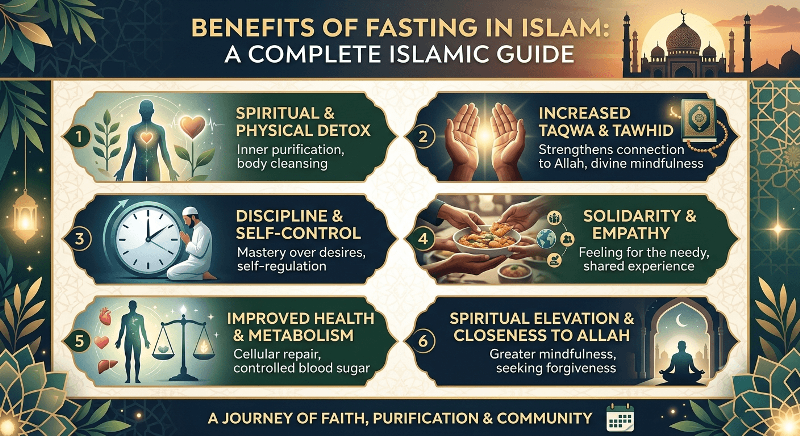
What Are the Benefits of Fasting in Islam?
Now let us explore the complete benefits of fasting in Islam — covering spiritual, social, and medical dimensions that make Sawm one of the most holistic acts of worship ever prescribed.
Spiritual & Moral Benefits of Fasting
Fasting in Islam is first and foremost a spiritual act — and its impact on the soul is profound and transformative:
1. Above All — It is an Act of Obedience to Allah
The greatest benefit of fasting is that it is a direct act of worship and obedience to Allah (SWT). Allah commanded it in the Qur’an:
“O you who believe! Fasting is prescribed for you as it was prescribed for those before you, so that you may achieve Taqwa.” — Surah Al-Baqarah (2:183)
Every moment of hunger and thirst endured for the sake of Allah is an act of pure submission and devotion.
2. Trains Believers in Taqwa
The Qur’an tells us the ultimate goal of fasting is Taqwa — being constantly mindful of Allah, fearing His displeasure, doing everything He commanded, and avoiding everything He forbade. Fasting is the most powerful training ground for building this God-consciousness in the heart.
3. Teaches Patience and Sincerity
Fasting requires Sabr (patience) — patience with hunger, thirst, fatigue, and the urge to sin. The Prophet ﷺ called Ramadan the “Month of Patience” and said that the reward of patience is Jannah.
4. Develops Endurance and Self-Restraint
By controlling the most basic human desires — food, drink, and physical pleasures — fasting builds extraordinary willpower and self-discipline that carries over into every area of a Muslim’s life.
5. Restricts the Movement of Shaytan
As confirmed in the Hadith above, the devils are chained in Ramadan — making it easier to resist temptation, avoid sin, and focus entirely on worship and remembrance of Allah.
6. Deepens the Connection with the Qur’an
Ramadan is the month the Qur’an was revealed. Muslims worldwide increase their recitation and reflection of the Qur’an during fasting — strengthening their bond with Allah’s word.
7. Complete Forgiveness of Past Sins
As confirmed in Hadith 2 — whoever fasts with sincere faith and hope in Allah’s reward will have all previous sins forgiven — returning to a state of purity after Ramadan.
Social Benefits of Fasting
Fasting is not just a personal act — it has powerful social and community dimensions that strengthen the entire Muslim Ummah:
1. Strengthens Unity and Equality Among Muslims
When the entire Muslim Ummah fasts together — rich and poor, king and servant, young and old — at the same times, with the same intention, it creates a powerful sense of universal brotherhood and equality that no other act of worship matches.
2. Teaches Sympathy Towards the Poor and Needy
By personally experiencing hunger and thirst, fasting Muslims develop a deep, genuine empathy for those who go without food every day. This compassion translates into increased charity, Zakat, and Sadaqah during Ramadan — making it the most generous month of the year.
3. Strengthens Family and Community Bonds
The shared experience of Suhoor (pre-dawn meal) and Iftar (breaking the fast) brings families and communities together in a way that strengthens relationships and creates lasting bonds of love and belonging.
4. Encourages Generosity and Giving
The Prophet ﷺ was described as being “more generous in Ramadan than the fast wind” — and Muslims worldwide follow his example by increasing their charity, feeding others at Iftar, and giving Zakat during this blessed month.
Medical Benefits of Fasting
Modern science has increasingly confirmed what Islam established 1,400 years ago — that fasting has remarkable benefits for the human body:
1. Rests and Detoxifies the Digestive System
Fasting gives the digestive organs a complete rest from their constant work — allowing the body to eliminate accumulated waste, repair cells, and reset the digestive system. This process, known as autophagy, has been recognized by modern medicine as one of the most powerful natural healing mechanisms.
2. Reduces Cholesterol and Protects the Heart
Scientific studies have shown that fasting reduces stored cholesterol and unhealthy fats in the bloodstream — one of the leading causes of heart disease, stroke, and cardiovascular illness. Ramadan fasting has been linked to measurable improvements in heart health markers.
3. Teaches Self-Control Over Harmful Habits
Fasting trains Muslims to control overeating, smoking, and other harmful habits — disciplines that extend beyond Ramadan and contribute to long-term health and well-being.
4. Improves Mental Clarity and Focus
When the body is not busy digesting food, mental clarity, focus, and cognitive function often improve significantly. Many who fast report heightened concentration, better mood, and increased mental sharpness.
5. Regulates Blood Sugar and Metabolism
Fasting helps stabilize blood sugar levels and improve insulin sensitivity — reducing the risk of type 2 diabetes and metabolic disorders.
Complete Benefits Summary — Fasting in Islam at a Glance
| Category | Benefit |
| Spiritual | Act of obedience to Allah |
| Spiritual | Builds Taqwa (God-consciousness) |
| Spiritual | Teaches patience and sincerity |
| Spiritual | Develops endurance and self-restraint |
| Spiritual | Restricts the movement of Shaytan |
| Spiritual | Complete forgiveness of past sins |
| Social | Strengthens unity and equality among Muslims |
| Social | Teaches sympathy for the poor and needy |
| Social | Strengthens family and community bonds |
| Social | Encourages generosity and giving |
| Medical | Rests and detoxifies the digestive system |
| Medical | Reduces cholesterol and protects heart health |
| Medical | Teaches self-control over harmful habits |
| Medical | Improves mental clarity and focus |
| Medical | Regulates blood sugar and metabolism |
What Happens to Your Body and Mind When You Fast in Islam?
Here is a simple timeline of what happens during a day of Islamic fasting:
| Time | What Happens in Your Body & Mind |
| Suhoor (pre-dawn) | Body fuels up for the fast — intention (Niyyah) activates the spiritual reward |
| First few hours | Blood sugar stabilizes — body begins drawing on stored energy |
| Midday | Digestive system rests — mental focus often sharpens |
| Afternoon | Body enters fat-burning mode — cholesterol begins reducing |
| Before Maghrib | Peak spiritual state — du’a at this time is highly recommended |
| Iftar (sunset) | First moment of joy — body replenishes, gratitude to Allah intensifies |
| Night prayers (Tarawih) | Soul is nourished — Quran recitation deepens the spiritual experience |
Conclusion
Fasting in Islam (Siyam) is one of the most complete and multi-dimensional acts of worship ever prescribed. It benefits the soul through obedience, Taqwa, and forgiveness. It benefits society through unity, empathy, and generosity. And it benefits the body through detoxification, improved heart health, and self-discipline.
Above all — as Allah declared in the Hadith Qudsi:
“Fasting is for Me, and I will personally grant its reward.”
No calculator can measure that reward. No human mind can fully comprehend it. The only fitting response is to fast with full sincerity, full faith, and full hope in the promise of Allah.
May Allah (Subhanahu Wa Ta’ala) guide all of us to His truth, purify our intentions, allow us to witness many Ramadans, accept our fasting with the highest reward, forgive all our sins, and make us among the people of Taqwa. May He, by His infinite Mercy, grant us all entry into Jannah together. Ameen, Ya Rabbal ‘Alameen.
Jazakallahu Khayran!
Tags: benefits of fasting in Islam, Siyam meaning in Islam, spiritual benefits of fasting in Ramadan, medical benefits of Islamic fasting, social benefits of fasting, Hadith on fasting, Ramadan fasting rewards, what happens when you fast in Islam, Taqwa through fasting, sins forgiven in Ramadan
