Introduction
Imagine a world where the wealthy are purified from greed, the poor are lifted from poverty, and society is bound together by a divine system of justice and compassion. This is precisely what Zakat — the fourth pillar of Islam — was designed to achieve.
Zakat is not merely a charitable donation — it is a religious obligation, a spiritual purification, and a social responsibility all woven into one powerful act of worship. It is Allah’s divinely ordained system for redistributing wealth and ensuring that no member of the Muslim community is left behind.
In this comprehensive guide, we explore the meaning, definition, Quranic evidence, benefits, forms of wealth, and recipients of Zakat in Islam.
What is the Fourth Pillar of Islam?
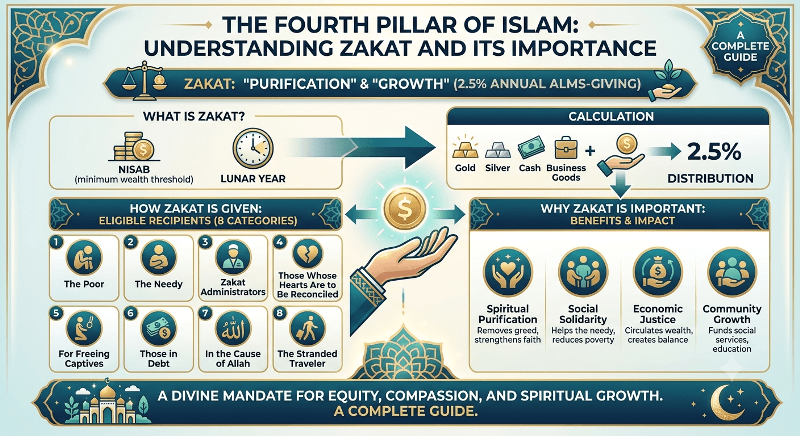
The fourth pillar of Islam is Zakat — the obligatory annual charity that every financially eligible Muslim must give from their wealth. It stands as one of the most important acts of worship in Islam, combining devotion to Allah with service to humanity.
Quick Reference Card
| Detail | Info |
| Pillar Number | Fourth Pillar of Islam |
| Arabic Name | Zakat (زَكَاة) |
| Literal Meaning | Purification & Growth |
| Type | Obligatory (Fard) — not optional |
| Amount | 2.5% of eligible wealth held for one lunar year |
| Minimum Threshold | Nisab (minimum qualifying wealth) |
| Key Quranic Reference | Surah At-Tawbah (9:60) |
| Primary Purpose | Purification of wealth & social justice |
What is the Meaning of Zakat?
The word Zakat (زَكَاة) in Arabic carries two beautiful and complementary meanings:
| Arabic Meaning | Explanation |
| Purification (Tazkiyah) | Zakat purifies the remaining wealth of the giver by removing the spiritual impurity of greed and attachment |
| Growth (Nama) | By giving Zakat, Allah blesses and increases the giver’s remaining wealth — both in this world and the Hereafter |
This is the wisdom of Allah — by giving away a portion of wealth, a Muslim actually gains more in blessing, purity, and divine reward.
What Does the Qur’an Say About Zakat?
Quranic Verse 1 — The Command to Give Zakat
Allah (Subhanahu Wa Ta’ala) links Zakat directly with Salah — the two most important pillars of Islam — in a powerful command:
وَأَقِيمُوا الصَّلَاةَ وَآتُوا الزَّكَاةَ وَأَطِيعُوا الرَّسُولَ لَعَلَّكُمْ تُرْحَمُونَ
“Establish Salah, give Zakat, and obey the Messenger — so that you may receive mercy.” — Surah An-Nur (24:56)
Key Insights From This Verse:
- Salah and Zakat are mentioned together — throughout the Qur’an, these two pillars are paired over 80 times, showing their equal importance
- “Obey the Messenger” — giving Zakat is also an act of following the Sunnah of the Prophet ﷺ
- “So that you may receive mercy” — Zakat is a direct path to earning Allah’s infinite mercy in this life and the next
Quranic Verse 2 — Who Receives Zakat?
Allah (SWT) defines the eight categories of Zakat recipients with complete precision in the Qur’an:
إِنَّمَا الصَّدَقَاتُ لِلْفُقَرَاءِ وَالْمَسَاكِينِ وَالْعَامِلِينَ عَلَيْهَا وَالْمُؤَلَّفَةِ قُلُوبُهُمْ وَفِي الرِّقَابِ وَالْغَارِمِينَ وَفِي سَبِيلِ اللَّهِ وَابْنِ السَّبِيلِ فَرِيضَةً مِّنَ اللَّهِ وَاللَّهُ عَلِيمٌ حَكِيمٌ
“Verily, Zakat is only for the poor, the needy, those employed to collect it, those whose hearts are to be won over, for freeing slaves, for those in debt, in the cause of Allah, and for the stranded traveler — an obligation imposed by Allah. And Allah is All-Knowing, All-Wise.” — Surah At-Tawbah (9:60)
What is the Definition of Zakat in Islam?
Zakat is formally defined as:
“An obligatory act of charity (Sadaqah) due on specific forms of wealth, given under certain conditions, to specific categories of recipients, at a specific time — as an act of worship and obedience to Allah.”
Four key conditions make Zakat obligatory:
| Condition | Detail |
| Muslim | Only Muslims are obligated to pay Zakat |
| Nisab | Wealth must meet or exceed the minimum threshold (Nisab) |
| Hawl | Wealth must have been held for a full Islamic lunar year |
| Full Ownership | The wealth must be fully owned and not owed to others |
Forms of Wealth on Which Zakat is Due
Not all wealth is subject to Zakat. Islam has specified four main categories of wealth on which Zakat must be paid:
1. Gold, Silver & Money
- Gold — Nisab is 85 grams of gold
- Silver — Nisab is 595 grams of silver
- Cash, bank savings, and investments — calculated at 2.5% of total savings held for one lunar year
2. Trade Goods & Business Inventory
Any goods held for the purpose of sale are subject to Zakat, including:
- Vehicles and machinery for sale
- Land and real estate purchased for resale
- Animals purchased for trade
- Food products and merchandise
3. Livestock & Animals
Zakat on livestock applies to:
- Sheep and goats — Nisab starts at 40 animals
- Cows and bulls — Nisab starts at 30 animals
- Camels — Nisab starts at 5 camels
4. Agricultural Produce
Zakat on crops is due at harvest time on specific produce, including:
- Wheat and barley
- Corn and rice
- Dates and raisins
- Other staple crops
Note: The rate for rain-irrigated crops is 10%, and for artificially irrigated crops it is 5%.
The 8 Recipients of Zakat — As Defined by Allah in the Qur’an
Allah (SWT) has precisely defined eight categories of people who are eligible to receive Zakat in Surah At-Tawbah (9:60):
| # | Recipient | Arabic | Explanation |
| 1 | The Poor (Al-Fuqara) | الْفُقَرَاء | Those with little or no income who cannot meet their basic needs |
| 2 | The Needy (Al-Masakeen) | الْمَسَاكِين | Those who have some income but still cannot meet all their basic needs |
| 3 | Zakat Collectors (Al-Amileen) | الْعَامِلِينَ عَلَيْهَا | Those officially appointed to collect and distribute Zakat |
| 4 | New Muslims (Al-Muallafatu Quloobuhum) | الْمُؤَلَّفَةِ قُلُوبُهُمْ | Those whose hearts are being won over to Islam or whose faith is being strengthened |
| 5 | Freeing Slaves (Fi Ar-Riqab) | فِي الرِّقَابِ | For the emancipation of slaves and captives (historically) |
| 6 | Those in Debt (Al-Gharimeen) | الْغَارِمِين | Those overwhelmed by debt they cannot repay |
| 7 | In the Cause of Allah (Fi Sabilillah) | فِي سَبِيلِ اللَّهِ | Those striving in Allah’s cause — scholars, students of knowledge, and those defending the Ummah |
| 8 | Stranded Travelers (Ibn As-Sabil) | ابْنِ السَّبِيلِ | Travelers who are stranded and in need, far from their home and wealth |
Benefits of Giving Zakat — Why Every Muslim Should Give
Zakat is not just a financial transaction — it is a transformative act of worship that benefits the giver, the receiver, and society as a whole:
Benefits for the Giver:
- An act of obedience to Allah — the greatest benefit of all
- Purifies wealth — removes spiritual impurity from earnings
- Purifies the heart from greed — teaching detachment from worldly wealth
- Increases blessings (Barakah) — Allah multiplies what remains after Zakat
- Earns immense reward — the Prophet ﷺ said charity never decreases wealth
- Protection on the Day of Judgment — Zakat will shade the giver on the Day of Resurrection
- Path to Allah’s mercy — as stated in Surah An-Nur (24:56)
Benefits for the Recipient:
- Purifies the heart from envy and jealousy toward the wealthy
- Meets basic needs — food, shelter, and clothing for the poor
- Restores dignity — helping people stand on their own feet
- Strengthens brotherhood — reminding recipients that the Muslim community cares for them
Benefits for Society:
- Reduces poverty and inequality — wealth circulates from the rich to the poor
- Builds a just and compassionate community — fulfilling Islam’s vision of social justice
- Strengthens the bonds of the Ummah — uniting Muslims through shared responsibility
- Eliminates hoarding of wealth — ensuring money flows and benefits all of society
The Difference Between Zakat and Sadaqah
Many Muslims confuse Zakat with general charity. Here is the key distinction:
| Zakat | Sadaqah (Voluntary Charity) | |
| Obligation | Obligatory (Fard) | Voluntary |
| Amount | Fixed (2.5% of eligible wealth) | Any amount |
| Timing | Once a year (after Hawl) | Anytime |
| Recipients | Only the 8 Quranic categories | Anyone in need |
| Purpose | Purification of wealth | General good deed |
Both are beloved to Allah — but Zakat cannot be replaced by Sadaqah. They are separate acts of worship with distinct rules and purposes.
How to Calculate Your Zakat — Simple Steps
Here is a simple 4-step process to calculate your Zakat:
Step 1 — Add up all your eligible wealth (cash, gold, silver, business inventory, investments)
Step 2 — Subtract all your immediate debts and liabilities
Step 3 — Check if the remaining amount meets or exceeds the Nisab threshold
Step 4 — If it does, and you have held it for one full lunar year, pay 2.5% as Zakat
Example: If your total eligible wealth is $10,000, your Zakat is: $10,000 × 2.5% = $250
Consequences of Withholding Zakat
Zakat is not optional — withholding it is considered a major sin in Islam. Allah warns in the Qur’an:
“And those who hoard gold and silver and do not spend it in the way of Allah — give them tidings of a painful punishment.” — Surah At-Tawbah (9:34)
This verse serves as a powerful reminder that wealth is a trust from Allah — and Zakat is the minimum we owe from that trust.
Summary — Zakat at a Glance
| Aspect | Detail |
| What is it? | Obligatory annual charity — 4th Pillar of Islam |
| Who pays? | Every eligible adult Muslim |
| How much? | 2.5% of eligible wealth above Nisab |
| When? | After holding wealth for one full lunar year (Hawl) |
| Who receives? | 8 categories defined in Surah At-Tawbah (9:60) |
| Primary benefit | Purification of wealth & earning Allah’s mercy |
| Consequence of avoiding | Major sin — warned against in Surah At-Tawbah (9:34) |
Conclusion
Zakat is far more than a financial obligation — it is Allah’s divine blueprint for a just, compassionate, and unified society. It purifies the giver’s wealth and heart, uplifts the poor and vulnerable, and strengthens the bonds of the entire Muslim Ummah.
When you give Zakat, you are not losing wealth — you are investing it with Allah, Who promises to multiply it in ways beyond our imagination. As the Prophet Muhammad ﷺ said:
“Charity does not decrease wealth.” — [Sahih Muslim]
May Allah (Subhanahu Wa Ta’ala) make us among those who give Zakat willingly and sincerely, accept it as an act of worship, purify our wealth and hearts, and bless us with abundance. May He forgive our shortcomings and, by His infinite Mercy, grant us all entry into Jannah. Ameen, Ya Rabbal ‘Alameen.
Jazakallahu Khayran!
Tags: fourth pillar of Islam, Zakat in Islam, Zakat meaning in English, how to calculate Zakat, recipients of Zakat, Surah At-Tawbah 9:60, Zakat vs Sadaqah, Nisab for Zakat, importance of Zakat, obligatory charity in Islam, forms of wealth for Zakat
