Introduction
Islam is one of the world’s largest religions, with over 1.8 billion followers across the globe. At its core, Islam means “submission to the will of Allah” — the one true God worthy of all worship — and living according to His divine laws.
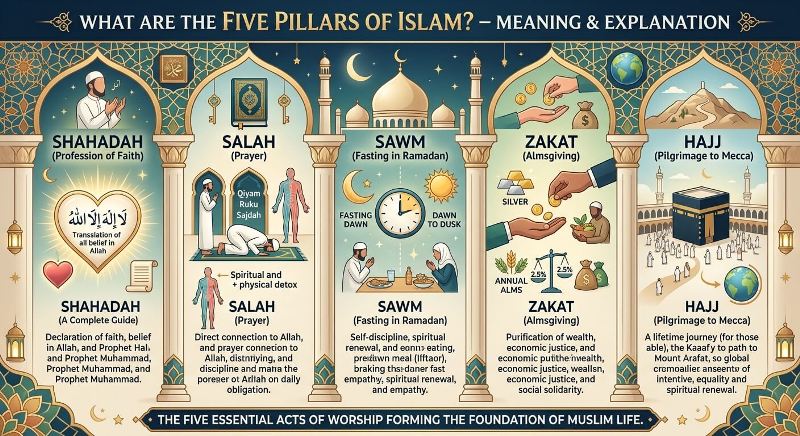
The entire practice of Islam is built upon 5 fundamental pillars. These pillars are not just rituals — they are the backbone of a Muslim’s faith, worship, and daily life. Every Muslim, regardless of their background or nationality, is united by these five acts of devotion.
In this guide, we will explore each of the 5 Pillars of Islam in English, their Arabic names, meanings, and why they are so important for every Muslim.
What Are the 5 Pillars of Islam?
| # | Pillar | Arabic Name | Meaning |
| 1 | Faith | Shahadah (شَهَادَة) | Declaration of Faith |
| 2 | Prayer | Salah (صَلَاة) | Ritual Prayer 5 Times Daily |
| 3 | Fasting | Sawm (صَوْم) | Fasting in Ramadan |
| 4 | Charity | Zakat (زَكَاة) | Obligatory Almsgiving |
| 5 | Pilgrimage | Hajj (حَجّ) | Pilgrimage to Makkah |
Pillar 1: Shahadah (Faith) — شَهَادَة
What is Shahadah?
The Shahadah is the first and most fundamental pillar of Islam. It is the declaration of faith that every Muslim must sincerely believe in and proclaim. Reciting the Shahadah with full conviction is what makes a person a Muslim.
Shahadah in Arabic:
أَشْهَدُ أَنْ لَا إِلَٰهَ إِلَّا اللَّهُ وَأَشْهَدُ أَنَّ مُحَمَّدًا رَسُولُ اللَّهِ
Shahadah Meaning in English:
“I testify that none has the right to be worshiped except Allah, and I testify that Muhammad (ﷺ) is the Messenger of Allah.”
Why is Shahadah Important?
- It is the entry point into Islam — anyone who sincerely recites it becomes a Muslim
- It affirms the Oneness of Allah (Tawheed) — the most important concept in Islam
- It acknowledges Prophet Muhammad ﷺ as the final messenger of Allah
- It is recited in the Adhan (call to prayer) five times every day
- A Muslim’s life begins and ends with the Shahadah
Pillar 2: Salah (Prayer) — صَلَاة
What is Salah?
Salah is the second pillar of Islam and refers to the five daily ritual prayers that every Muslim is obligated to perform. It is the most consistent act of worship in a Muslim’s life — performed five times every single day.
The 5 Daily Prayers:
| Prayer | Arabic Name | Time |
| 1 | Fajr (فَجْر) | Dawn — before sunrise |
| 2 | Dhuhr (ظُهْر) | Midday — after the sun passes its zenith |
| 3 | Asr (عَصْر) | Afternoon |
| 4 | Maghrib (مَغْرِب) | Just after sunset |
| 5 | Isha (عِشَاء) | Night |
Key Facts About Salah:
- Salah can be performed alone or in congregation — though praying in congregation carries greater reward
- It can be performed at home, at work, or outdoors — though praying in a mosque is highly recommended
- It establishes a direct, personal connection between the believer and Allah — no intermediary is needed
- Salah was made obligatory during the Night of Ascension (Isra wal Mi’raj)
- It serves as a constant reminder of Allah throughout the day, keeping a Muslim grounded and focused
Pillar 3: Sawm (Fasting) — صَوْم
What is Sawm?
Sawm is the third pillar of Islam — the obligatory fasting observed during the holy month of Ramadan, the ninth month of the Islamic lunar calendar. Every adult Muslim who is physically able is required to fast from Fajr (dawn) until Maghrib (sunset).
What Does Fasting in Ramadan Involve?
During the fast, Muslims abstain from:
- Eating and drinking (including water)
- Smoking
- Sinful speech and actions
- Intimate relations during fasting hours
Why is Sawm Important?
Allah (SWT) says in the Qur’an:
“O you who believe! Fasting is prescribed for you as it was prescribed for those before you, so that you may become righteous (Muttaqeen).” — Surah Al-Baqarah (2:183)
- Fasting purifies the soul and strengthens self-discipline
- It increases Taqwa (God-consciousness) and mindfulness of Allah
- It builds empathy and gratitude by experiencing hunger like those less fortunate
- The rewards of fasting are immense — Allah personally rewards those who fast sincerely
- Ramadan is the month the Qur’an was revealed — making it the most blessed month of the year
Pillar 4: Zakat (Charity) — زَكَاة
What is Zakat?
Zakat is the fourth pillar of Islam — the obligatory annual charity that every financially capable Muslim must give. It is not optional generosity; it is a religious duty and an act of worship.
How is Zakat Calculated?
- Zakat is 2.5% of a Muslim’s total savings and wealth that has been held for a full lunar year
- It applies only to those whose wealth exceeds the Nisab threshold (minimum amount of wealth)
- It must be given to specific categories of recipients as defined in the Qur’an (Surah At-Tawbah 9:60)
Who Can Receive Zakat?
According to the Qur’an, Zakat is distributed to:
- The poor and needy
- Those in debt
- New Muslims
- Travelers in need
- For freeing Slaves
- Those working to collect and distribute Zakat
- Those striving in the cause of Allah
Why is Zakat Important?
- It purifies wealth and removes greed and attachment from the heart
- It reduces poverty and creates a more just and equal society
- It fulfills a Muslim’s social responsibility to the community
- The word Zakat itself means “purification and growth” in Arabic
- Withholding Zakat is considered a major sin in Islam
Pillar 5: Hajj (Pilgrimage) — حَجّ
What is Hajj?
Hajj is the fifth and final pillar of Islam — the annual pilgrimage to the holy city of Makkah in Saudi Arabia. It is obligatory at least once in a lifetime for every Muslim who is physically and financially able to make the journey.
When Does Hajj Take Place?
Hajj is performed during the Islamic month of Dhul Hijjah (the 12th month of the Islamic lunar calendar), specifically from the 8th to the 13th of the month.
Key Rituals of Hajj:
- Wearing Ihram (white seamless garments symbolizing equality and purity)
- Tawaf — circling the Kaabah seven times
- Sa’i — walking seven times between the hills of Safa and Marwa
- Standing at Arafah — the most important ritual of Hajj
- Stoning the Jamarat — symbolizing the rejection of Shaytan
- Eid Al-Adha — the sacrifice offered at the end of Hajj
Why is Hajj Important?
Allah (SWT) says in the Qur’an:
“Pilgrimage to this House is an obligation by Allah upon whoever is able among the people. And whoever disbelieves — then indeed, Allah is free from need of the worlds.” — Surah Ali ‘Imran (3:97)
- Hajj is the largest annual gathering of people on Earth — a powerful symbol of Muslim unity
- It wipes away all past sins — a Muslim returns from Hajj as pure as the day they were born
- It is the ultimate act of submission to Allah — leaving everything behind to answer His call
- It connects Muslims to the legacy of Prophet Ibrahim (AS) and Prophet Muhammad ﷺ
Summary — 5 Pillars of Islam at a Glance
| Pillar | Name | Obligation | Key Purpose |
| Shahadah (Faith) | Always | Declaration of belief in Allah & His Messenger | |
| Salah (Prayer) | 5 times daily | Direct connection with Allah | |
| Sawm (Fasting) | Once a year (Ramadan) | Purification of soul & Taqwa | |
| Zakat (Charity) | Annually (if eligible) | Purification of wealth & social justice | |
| Hajj (Pilgrimage) | Once in a lifetime (if able) | Ultimate act of submission to Allah |
Conclusion
The 5 Pillars of Islam are the foundation upon which every Muslim builds their relationship with Allah. They are not merely religious obligations — they are a complete system of spiritual, social, and personal development that guides a Muslim through every aspect of life.
From the declaration of faith (Shahadah) to the pilgrimage to Makkah (Hajj), each pillar carries deep meaning, immense reward, and a unique purpose in shaping a Muslim’s character and strengthening their bond with Allah.
May Allah (Subhanahu Wa Ta’ala) accept all our good deeds, guide us to fulfill all five pillars with sincerity and devotion, forgive our shortcomings, and make us among the people of Taqwa. May He, by His infinite Mercy, grant us all entry into Jannah. Ameen, Ya Rabbal ‘Alameen.
Jazakallahu Khayran!
Tags: 5 pillars of Islam in English, five pillars of Islam, Shahadah meaning, Salah in Islam, Sawm fasting Ramadan, Zakat in Islam, Hajj pilgrimage, what are the pillars of Islam, Islamic guide for beginners, Islam basics in English
